Loading…
Residence Nouveau
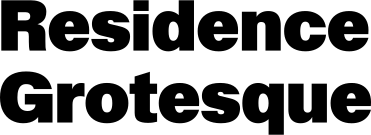
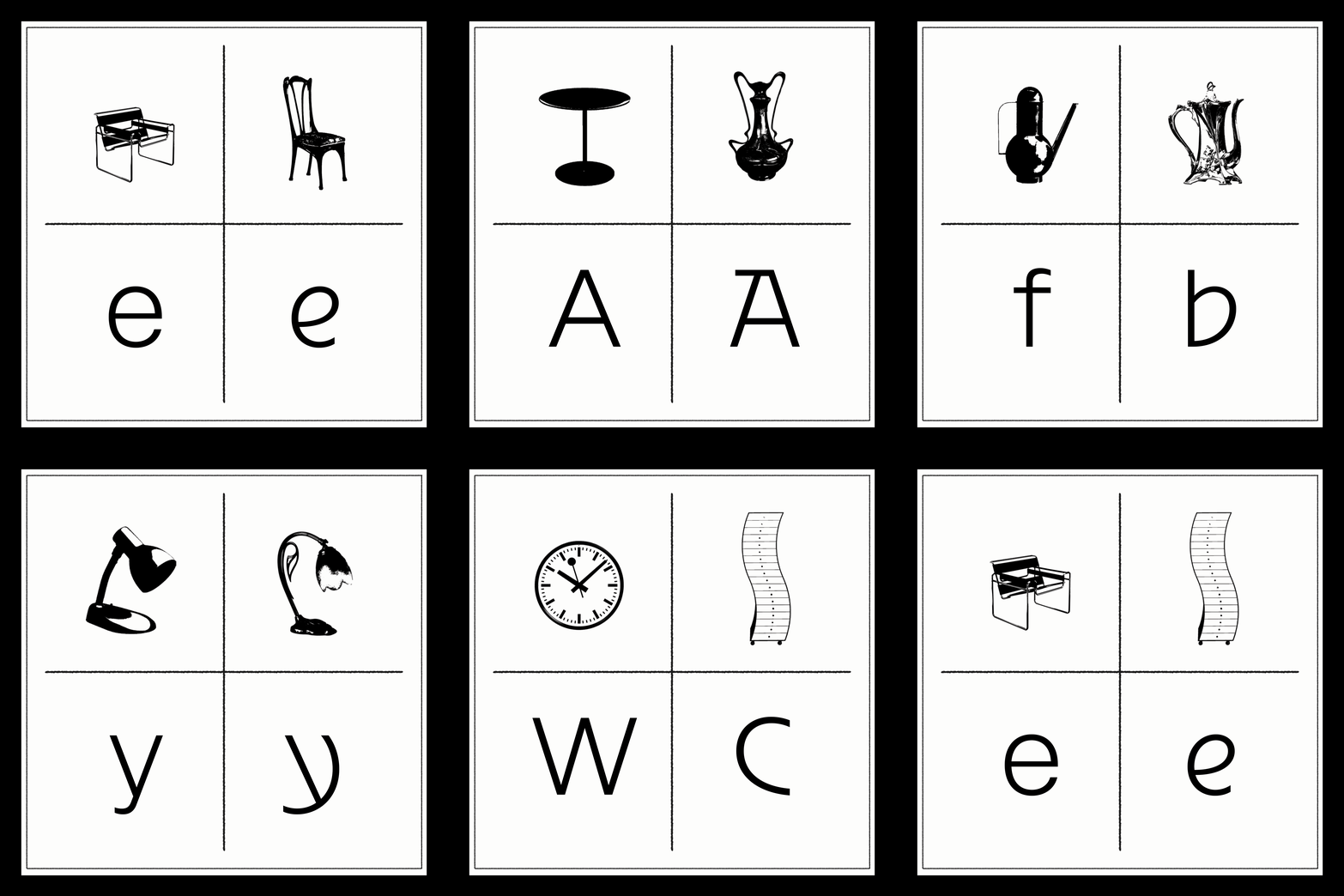
Residence by Kia Tasbihgou is an unexpected marriage of antiquated and contemporaneous sans serif families who live happily under a single roof of design space. Residence Nouveau’s sensual swashes and perfectly skewed curves are united in spirit and metric with its full-blooded, full-bodied grotesque counterpart. If the foundation of Residence is a rigorously rational approach to geometry, its stylistic gestures—not a novelty here, but rather core tenets of the font’s personality—complete the Gesamtkunstwerk of Kia’s second collaboration with Sharp Type. Residence brims with emotional resonance and technical specificity. Kia started the build for Residence in 2024 after encountering Aviso in a Berthold specimen. He became interested in the possibility of an Art Nouveau-derived sans serif built for today. Residence Grotesque was subsequently developed alongside the Nouveau as a more contemporary counterpart, using Folio as a model, and thereby establishing a dialogue between regionally and historically distinct sans serif forms.
Designer: Kia Tasbihgou | Engineer: Glenda Bellarosa & Calvin Kwok | Kerning: Igino Marini | Graphics: Sam de Groot
Version History
Version 1.000Residence Superfamily
Extrabold Nouveau

Extrabold Cursive


Loading…
100
-17
▼
▼
Kleingeld
Soutenez
▼
▼
Scherben
Roomfuls
▼
▼
Everyone
Instituted
▼
▼
Lawrence
Vermietet
▼
▼
Perplexity
Aceptaste
▼
▼
Étiquettes
Splendour
▼
▼
Vergebens
Slowdown
▼
▼
Dextrously
Geschoven
Weights Overview
RRRRRRRR

ExtraBold
35
It is defined by strict adherence to functional and utilitarian designs and construction methods, typically expressed through minimalism. The style is characterized by modular and rectilinear forms, flat surfaces devoid of ornamentation and decoration, open and airy interiors that blend with the exterior, and the use of glass, steel, and concrete.
ExtraBold Cursive
35
Her gesso panels for the Willow Tearooms on Sauchiehall Street (commissioned by Catherine Cranston) — particularly The May Queen and The Wassail (1900). The Villa Koliba, the Villa Pod Jedlami, and the Chapel of the Sacred Heart at Jaszczurówka anchor a regional movement that paralleled the broader Central European search for national architectural idioms within Continental Art Nouveau.
ExtraBold
25
The Polish painter, architect, and theorist Stanisław Witkiewicz developed in Zakopane in the southern Tatra mountains a distinctively Polish variant of National Romantic architecture — the Zakopane Style — drawing on the timber vernacular of the Tatra highlanders. The Villa Koliba, the Villa Pod Jedlami, and the Chapel of the Sacred Heart at Jaszczurówka anchor a regional movement that paralleled the broader Central European search for national architectural idioms within Continental Art Nouveau.
ExtraBold Cursive
25
The Glasgow-trained painter and decorative artist Margaret Macdonald Mackintosh (1864–1933) was a central figure of the Glasgow School and the principal collaborator on the interiors that defined her husband Charles Rennie Mackintosh's reputation. With her sister Frances Macdonald and Frances's husband Herbert MacNair, she formed The Four, the central designer group of the Glasgow School whose work was shown at the eighth Vienna Secession exhibition in 1900 and influenced the Continental development of Sezessionstil. Her gesso panels for the Willow Tearooms on Sauchiehall Street (commissioned by Catherine Cranston) — particularly The May Queen and The Wassail (1900) — and her embroidered fabrics, watercolor panels, and stenciled friezes were integrated into the principal Mackintosh interiors at Hill House in Helensburgh, the Glasgow School of Art Library, and the various Cranston tearooms across central Glasgow. Mackintosh himself remarked in his later correspondence that he had been "only the architect" and that "Margaret has genius" — a recognition that subsequent scholarship has restored against the long tendency to subordinate her contribution to his architectural reputation. After Mackintosh's death in 1928 she lived in straitened circumstances in London with their joint papers, drawings, and remaining furniture; her own death in 1933 ended a partnership whose joint authorship has only in the past three decades been adequately disentangled.
▼
▼
ExtraBold
35
The Crown Hall at IIT, and the New National Gallery in Berlin define a career-long meditation on universal space, structural expression, and the dictum "less is more." His unbuilt projects — particularly the brick country house and the glass skyscraper studies of the early 1920s — proved nearly as influential as his completed work.
ExtraBold Cursive
35
Between 1890 and 1930, Guimard designed and built some 50 buildings, in addition to 141 subway entrances for the Paris Métro, as well as numerous pieces of furniture and other decorative works. However, in the 1910s Art Nouveau went out of fashion and by the 1960s most of his works had been demolished, and only two of his original Métro édicules were still in place. Guimard's critical reputation revived in the 1960s, in part due to subsequent acquisitions of his work by the Museum of Modern Art, and art historians have noted the originality and importance of his architectural and decorative works
ExtraBold
25
Mies brought to the International Style a discipline of proportion and detail that has rarely been equalled, his career organized around a small number of theoretical positions pursued with extraordinary consistency over six decades. The son of a stonemason in Aachen, he passed through the offices of Bruno Paul and Peter Behrens before establishing his own practice in Berlin, and as director of the Bauhaus from 1930 until its closure under political pressure in 1933, and later as head of architecture at the Illinois Institute of Technology in Chicago from 1938, he shaped two generations of modernist practice in both Germany and the United States. The Barcelona Pavilion of 1929 — designed for the Spanish state's pavilion at the International Exposition and reconstructed on its original site in 1986 — established the open free-plan model of pinwheeling marble walls beneath a thin slab roof, with the Barcelona Chair designed for the visit of the Spanish royal couple. The Tugendhat House in Brno, the Farnsworth House outside Plano, Illinois, the Seagram Building on Park Avenue in collaboration with Philip Johnson, the Crown Hall at IIT, and the New National Gallery in Berlin define a career-long meditation on universal space, structural expression, and the dictum "less is more." His unbuilt projects — particularly the brick country house and the glass skyscraper studies of the early 1920s — proved nearly as influential as his completed work.
ExtraBold Cursive
25
Guimard imported Art Nouveau to Paris after a 1894 visit to Horta in Brussels, redesigning the Castel Béranger apartment building on the rue La Fontaine in the 16th arrondissement of Paris (originally commissioned in a traditional style for the widow Madame Fournier) around the new vocabulary of curvilinear metalwork and plant-form ornament that he had observed in Belgium. The building, completed in 1898 with thirty-six apartments, won the City of Paris's first Concours de Façades for its decorative wrought-iron and ceramic work and brought Guimard immediate recognition in France.

▼
▼
Bold
35
A Bauhaus student under Gropius who became master of the school's carpentry workshop, Breuer made his earliest reputation in furniture — the Wassily Chair of 1925, derived from the tubular-steel frame of his bicycle, and the cantilevered Cesca Chair of 1928 remain in continuous production — before turning fully to architecture during his English exile after 1935.
Bold Cursive
35
Atelier Horta on the Rue Américaine (now the Horta Museum in the Saint-Gilles district of Brussels) together demonstrate his commitment to the Gesamtkunstwerk: every door handle, mosaic, stained-glass panel, and item of furniture designed in concert with the architectural whole. Four of his Brussels townhouses — Tassel, Solvay, van Eetvelde, and the Horta Museum — were inscribed as UNESCO World Heritage in 2000.
Bold
25
His brief partnership with F.R.S. Yorke in London produced the Gane Pavilion in Bristol and other small commissions, and his American houses — including his own first and second residences in Lincoln, Massachusetts, the Geller House on Long Island, and a long sequence of bi-nuclear plans separating bedrooms from living spaces — established a regional modernism of stone, wood, and butterfly roofs that proved widely imitable in postwar suburban construction. Later monumental works such as the Whitney Museum of American Art on Madison Avenue in New York (1966), the UNESCO Headquarters in Paris (with Pier Luigi Nervi and Bernard Zehrfuss), Saint John's Abbey Church in Collegeville, Minnesota, and the former Department of Housing and Urban Development Building in Washington carried the International Style into a brutalist register of board-formed concrete and cantilevered geometry. His drawings for the projected Grand Central Tower — which would have demolished the existing terminal — became a focal point of the early American historic preservation movement.
Bold Cursive
25
The Belgian architect Victor Horta is conventionally credited with the first fully Art Nouveau building: the Hôtel Tassel in Brussels, completed in 1893 for Professor Émile Tassel of the Université libre de Bruxelles, whose interior introduced the whiplash iron line that would define the movement. The narrow town-house lot required Horta to organize the principal rooms around a central iron-and-glass octagonal stair hall that drew daylight down through the building and articulated its sectional logic in a single sweeping gesture, and the iron columns, banisters, and floor mosaics were drawn in continuous curling lines that synchronized the building's structure with its ornament. The Hôtel Solvay (1894, commissioned by the chemical-industry magnate Armand Solvay and built over six years on the Avenue Louise with no expense spared); the Hôtel van Eetvelde (1895, commissioned by the senior colonial administrator Edmond van Eetvelde and notable for its central octagonal salon with iron tracery in the African vegetation Eetvelde had encountered in the Congo); the Maison du Peuple in Brussels (1899, the headquarters of the Belgian Workers' Party — demolished 1965 in one of the most-protested losses of the European twentieth century); and the Maison & Atelier Horta on the Rue Américaine (now the Horta Museum in the Saint-Gilles district of Brussels) together demonstrate his commitment to the Gesamtkunstwerk: every door handle, mosaic, stained-glass panel, and item of furniture designed in concert with the architectural whole. Four of his Brussels townhouses — Tassel, Solvay, van Eetvelde, and the Horta Museum — were inscribed as UNESCO World Heritage in 2000.
Grotesque Oblique
12
Curator, polemicist, and architect, Johnson co-organized the 1932 MoMA exhibition that gave the International Style its name and spent the following decades alternately championing and dismantling its orthodoxies. The exhibition catalogue, co-authored with Henry-Russell Hitchcock, identified the three principles that the curators argued unified the disparate European modernist projects — volume over mass, regularity rather than symmetry, and the avoidance of applied decoration — and remained the standard introductory text on the movement for a generation. His Glass House in New Canaan, Connecticut, completed in 1949 on an estate that he steadily expanded with further pavilions over the next half century, refracts Mies's Farnsworth House into a private American idiom; the brick guest house, the lake pavilion, the underground painting gallery, and the sculpture gallery on the same property document his stylistic restlessness across the postwar decades. With Mies he designed the Seagram Building and its Four Seasons Restaurant interior, and his later work — the New York State Theater at Lincoln Center, the IDS Center in Minneapolis, the Pennzoil Place towers in Houston with John Burgee, and above all the broken-pediment AT&T Building (now Sony Tower) on Madison Avenue in New York — helped open the door to postmodernism. He received the inaugural Pritzker Prize in 1979. Curator, polemicist, and architect, Johnson co-organized the 1932 MoMA exhibition that gave the International Style its name and spent the following decades alternately championing and dismantling its orthodoxies. The exhibition catalogue, co-authored with Henry-Russell Hitchcock, identified the three principles that the curators argued unified the disparate European modernist projects — volume over mass, regularity rather than symmetry, and the avoidance of applied decoration — and remained the standard introductory text on the movement for a generation. His Glass House in New Canaan, Connecticut, completed in 1949 on an estate that he steadily expanded with further pavilions over the next half century, refracts Mies's Farnsworth House into a private American idiom; the brick guest house, the lake pavilion, the underground painting gallery, and the sculpture gallery on the same property document his stylistic restlessness across the postwar decades. With Mies he designed the Seagram Building and its Four Seasons Restaurant interior, and his later work — the New York State Theater at Lincoln Center, the IDS Center in Minneapolis, the Pennzoil Place towers in Houston with John Burgee, and above all the broken-pediment AT&T Building (now Sony Tower) on Madison Avenue in New York — helped open the door to postmodernism. He received the inaugural Pritzker Prize in 1979.
Bold Cursive
12
Guimard imported Art Nouveau to Paris after a 1894 visit to Horta in Brussels, redesigning the Castel Béranger apartment building on the rue La Fontaine in the 16th arrondissement of Paris (originally commissioned in a traditional style for the widow Madame Fournier) around the new vocabulary of curvilinear metalwork and plant-form ornament that he had observed in Belgium. The building, completed in 1898 with thirty-six apartments, won the City of Paris's first Concours de Façades for its decorative wrought-iron and ceramic work and brought Guimard immediate recognition in France. His commission in 1899 to design entrances for the new Paris Métro produced the cast-iron pavilions, balustrades, and lamp standards — the so-called Style Métro — that remain the most widely recognized public monuments of French Art Nouveau and that survive today at more than eighty Métro stations across the city, with the most fully realized examples at Porte Dauphine, Châtelet, and Place des Abbesses. The Hôtel Mezzara on the rue La Fontaine (commissioned by the silk merchant Paul Mezzara), the Synagogue de la rue Pavée in the 4th arrondissement (an unusually narrow site whose curving façade adapts the Art Nouveau vocabulary to a Jewish religious building, the only synagogue ever built in the style), the Castel Henriette in Sèvres, and his own residence at 122 avenue Mozart complete the principal Paris work, much of which has been lost to demolition. Guimard imported Art Nouveau to Paris after a 1894 visit to Horta in Brussels, redesigning the Castel Béranger apartment building on the rue La Fontaine in the 16th arrondissement of Paris (originally commissioned in a traditional style for the widow Madame Fournier) around the new vocabulary of curvilinear metalwork and plant-form ornament that he had observed in Belgium. The building, completed in 1898 with thirty-six apartments, won the City of Paris's first Concours de Façades for its decorative wrought-iron and ceramic work and brought Guimard immediate recognition in France. His commission in 1899 to design entrances for the new Paris Métro produced the cast-iron pavilions, balustrades, and lamp standards — the so-called Style Métro — that remain the most widely recognized public monuments of French Art Nouveau and that survive today at more than eighty Métro stations across the city, with the most fully realized examples at Porte Dauphine, Châtelet, and Place des Abbesses. The Hôtel Mezzara on the rue La Fontaine (commissioned by the silk merchant Paul Mezzara), the Synagogue de la rue Pavée in the 4th arrondissement (an unusually narrow site whose curving façade adapts the Art Nouveau vocabulary to a Jewish religious building, the only synagogue ever built in the style), the Castel Henriette in Sèvres, and his own residence at 122 avenue Mozart complete the principal Paris work, much of which has been lost to demolition.
▼
▼
SemiBold
35
the New York State Theater at Lincoln Center, the IDS Center in Minneapolis, the Pennzoil Place towers in Houston with John Burgee, and above all the broken-pediment AT&T Building (now Sony Tower) on Madison Avenue in New York — helped open the door to postmodernism. He received the inaugural Pritzker Prize in 1979.
SemiBold Cursive
35
The Catalan architect Antoni Gaudí carried the organic principles of Art Nouveau toward a register so personal that the Catalan variant he largely defined — Modernisme — is often considered a movement of its own, with Gaudí himself standing as the variant's principal figure and his commitment to Catholic devotion, Catalan nationalism, and organic mathematical form distinguishing his career from the more secular and decorative Continental Art Nouveau.
SemiBold
25
Austrian-born and trained in Vienna under Adolf Loos's influence, with further early experience in the office of Erich Mendelsohn in Berlin, Neutra emigrated to the United States in 1923 and settled in Los Angeles in 1925 after a period at Frank Lloyd Wright's Taliesin and in Rudolf Schindler's Kings Road House, where the two Vienna-trained émigrés briefly shared both house and practice. The climate and topography of Southern California proved congenial to a particular strain of West Coast modernism organized around horizontal planning, sliding glass walls, integrated landscape, and what Neutra called "biorealism"
SemiBold Cursive
25
His patron Eusebi Güell, the Catalan industrial magnate, commissioned the Palau Güell in central Barcelona (1888) and subsequently the Park Güell on Carmel Hill (originally conceived in 1900 as a private hilltop residential development that failed commercially and was given to the city as a public park in 1922). The Casa Vicens in the Gràcia district (1888, commissioned by the broker Manuel Vicens), the Casa Batlló on Passeig de Gràcia (1906, a renovation of an existing building into a fantastic sea-creature façade), the Casa Milà ("La Pedrera") on the same street (1912, the rough-cut stone façade of which his contemporaries compared to a quarry), and above all the still-unfinished Basílica de la Sagrada Família (begun 1882, projected completion 2026 on the centenary of Gaudí's death) collectively constitute one of the most extraordinary single-city architectural achievements of the modern era. Seven of his Barcelona works were inscribed as UNESCO World Heritage between 1984 and 2005. He died after being struck by a tram on the Gran Via in 1926, his death not immediately recognized because he had become so ascetic in his late years that he was mistaken for a beggar.
Weights Overview
GGGGGGGG
SemiBold
12
Austrian-born and trained in Vienna under Adolf Loos's influence, with further early experience in the office of Erich Mendelsohn in Berlin, Neutra emigrated to the United States in 1923 and settled in Los Angeles in 1925 after a period at Frank Lloyd Wright's Taliesin and in Rudolf Schindler's Kings Road House, where the two Vienna-trained émigrés briefly shared both house and practice. The climate and topography of Southern California proved congenial to a particular strain of West Coast modernism organized around horizontal planning, sliding glass walls, integrated landscape, and what Neutra called "biorealism" — a phenomenological attention to the psychological effect of architectural space on its inhabitants. The Lovell Health House in Los Angeles (1929), commissioned by the naturopath and Los Angeles Times columnist Philip Lovell, was the first steel-frame residence in the United States and the project that established Neutra's international reputation; the Kaufmann Desert House in Palm Springs (1946), built for the same Pittsburgh department-store heir for whom Frank Lloyd Wright had designed Fallingwater a decade earlier, distilled his interest in dissolving the boundary between interior and landscape into the most photographed midcentury house in the world. The VDL Studio and Residences in Silver Lake, the Tremaine House in Montecito, and a long sequence of further Los Angeles residences extended the practice across his career, and his collaboration with the photographer Julius Shulman defined the visual idiom through which Southern California modernism reached its broadest audience. Gaudí himself standing as the variant's principal figure and his commitment to Catholic devotion, Catalan nationalism, and organic mathematical form distinguishing his career from the more secular and decorative Continental Art Nouveau. His patron Eusebi Güell, the Catalan industrial magnate, commissioned the Palau Güell in central Barcelona (1888) and subsequently the Park Güell on Carmel Hill (originally conceived in 1900 as a private hilltop residential development that failed commercially and was given to the city as a public park in 1922). The Casa Vicens in the Gràcia district (1888, commissioned by the broker Manuel Vicens), the Casa Batlló on Passeig de Gràcia (1906, a renovation of an existing building into a fantastic sea-creature façade), the Casa Milà ("La Pedrera") on the same street (1912, the rough-cut stone façade of which his contemporaries compared to a quarry), and above all the still-unfinished Basílica de la Sagrada Família (begun 1882, projected completion 2026 on the centenary of Gaudí's death) collectively constitute one of the most extraordinary single-city architectural achievements of the modern era. Seven of his Barcelona works were inscribed as UNESCO World Heritage between 1984 and 2005. He died after being struck by a tram on the Gran Via in 1926, his death not immediately recognized because he had become so ascetic in his late years that he was mistaken for a beggar. Gaudí himself standing as the variant's principal figure and his commitment to Catholic devotion, Catalan nationalism, and organic mathematical form distinguishing his career from the more secular and decorative Continental Art Nouveau. His patron Eusebi Güell, the Catalan industrial magnate, commissioned the Palau Güell in central Barcelona (1888) and subsequently the Park Güell on Carmel Hill (originally conceived in 1900 as a private hilltop residential development that failed commercially and was given to the city as a public park in 1922). The Casa Vicens in the Gràcia district (1888, commissioned by the broker Manuel Vicens), the Casa Batlló on Passeig de Gràcia (1906, a renovation of an existing building into a fantastic sea-creature façade), the Casa Milà
SemiBold Cursive
12
Gaudí himself standing as the variant's principal figure and his commitment to Catholic devotion, Catalan nationalism, and organic mathematical form distinguishing his career from the more secular and decorative Continental Art Nouveau. His patron Eusebi Güell, the Catalan industrial magnate, commissioned the Palau Güell in central Barcelona (1888) and subsequently the Park Güell on Carmel Hill (originally conceived in 1900 as a private hilltop residential development that failed commercially and was given to the city as a public park in 1922). The Casa Vicens in the Gràcia district (1888, commissioned by the broker Manuel Vicens), the Casa Batlló on Passeig de Gràcia (1906, a renovation of an existing building into a fantastic sea-creature façade), the Casa Milà ("La Pedrera") on the same street (1912, the rough-cut stone façade of which his contemporaries compared to a quarry), and above all the still-unfinished Basílica de la Sagrada Família (begun 1882, projected completion 2026 on the centenary of Gaudí's death) collectively constitute one of the most extraordinary single-city architectural achievements of the modern era. Seven of his Barcelona works were inscribed as UNESCO World Heritage between 1984 and 2005. He died after being struck by a tram on the Gran Via in 1926, his death not immediately recognized because he had become so ascetic in his late years that he was mistaken for a beggar. Gaudí himself standing as the variant's principal figure and his commitment to Catholic devotion, Catalan nationalism, and organic mathematical form distinguishing his career from the more secular and decorative Continental Art Nouveau. His patron Eusebi Güell, the Catalan industrial magnate, commissioned the Palau Güell in central Barcelona (1888) and subsequently the Park Güell on Carmel Hill (originally conceived in 1900 as a private hilltop residential development that failed commercially and was given to the city as a public park in 1922). The Casa Vicens in the Gràcia district (1888, commissioned by the broker Manuel Vicens), the Casa Batlló on Passeig de Gràcia (1906, a renovation of an existing building into a fantastic sea-creature façade), the Casa Milà ("La Pedrera") on the same street (1912, the rough-cut stone façade of which his contemporaries compared to a quarry), and above all the still-unfinished Basílica de la Sagrada Família (begun 1882, projected completion 2026 on the centenary of Gaudí's death) collectively constitute one of the most extraordinary single-city architectural achievements of the modern era. Seven of his Barcelona works were inscribed as UNESCO World Heritage between 1984 and 2005. He died after being struck by a tram on the Gran Via in 1926, his death not immediately recognized because he had become so ascetic in his late years that he was mistaken for a beggar.
▼
▼
Medium
35
A founding member of the De Stijl group alongside Theo van Doesburg and Piet Mondrian in 1917, Jacobus Johannes Pieter Oud served as municipal housing architect for Rotterdam from 1918 to 1933, where he produced some of the most influential social housing of the interwar period.
Medium Cursive
35
A student of Wagner and a co-founder of the Vienna Secession in 1897 (with Klimt, Joseph Maria Olbrich, Koloman Moser, and Carl Moll) and the Wiener Werkstätte in 1903 (with Moser and the industrialist Fritz Waerndorfer as patron), Hoffmann produced in the Palais Stoclet in Brussels (1905–11) the most fully realized Gesamtkunstwerk
Medium
25
Rotterdam from 1918 to 1933, where he produced some of the most influential social housing of the interwar period. His Café De Unie on the Coolsingel in central Rotterdam (1925) restored a sliver of De Stijl color to the city center with its primary-color façade, and the Kiefhoek estate in the south of Rotterdam (1925–30) compressed the modernist row house into an exemplar of working-class dignity, with three hundred uniform single-family houses arranged around a small church and shops. His earlier Spangen and Tusschendijken housing blocks established his reputation, and his contribution to the Weissenhofsiedlung in Stuttgart (1927) — five row houses on the model exhibition estate organized by the Deutscher Werkbund and curated by Mies van der Rohe — confirmed his international standing. The Shell Building in The Hague, completed in 1942 during the German occupation of the Netherlands, marks the postwar moderation of his earlier radicalism and the architect's controversial late-career engagement with monumental classical proportion. His written interventions — particularly his 1921 essay "On Future Architecture and Its Architectural Possibilities" — placed him alongside Le Corbusier and Gropius as a principal theorist of European modernist housing.
Medium Cursive
25
The leading figure of the Glasgow School, Mackintosh worked in a more rectilinear and restrained idiom than his Continental contemporaries, anticipating in his tall-backed chairs and slender stenciled motifs both the Vienna Secession (which adopted his ideas after his exhibition at the eighth Secession show of 1900) and the broader transition toward early modernism. With his wife Margaret Macdonald, her sister Frances Macdonald, and Frances's husband Herbert MacNair — the group known collectively as "The Four"
Medium
12
Trained in Munich and active in Berlin during the Weimar years, Mendelsohn brought a kinetic, expressionist sensibility to modernist form that distinguished him from the more rectilinear Bauhaus tendency. The Einstein Tower at Potsdam (1921), a solar observatory of streaming concrete commissioned to enable Erwin Finlay-Freundlich's spectroscopic verification of general relativity, became an early icon of architectural modernism — its rounded forms originally sketched on the Russian front during Mendelsohn's wartime service. His Schocken department stores in Stuttgart (1928, demolished 1960), Chemnitz (now the Saxon State Museum of Archaeology), and Breslau extended that vocabulary to commercial use, with horizontal banded glazing wrapping curved corners in what became the signature German modernist department-store typology of the late Weimar period. The Mossehaus newspaper building in Berlin's Mitte district, the Universum Cinema on the Kurfürstendamm, and his own villa Am Rupenhorn established his Berlin practice as one of the most prolific of the late 1920s. Forced into exile in 1933 by his Jewish heritage, he practiced briefly in England in partnership with Serge Chermayeff — the De La Warr Pavilion at Bexhill-on-Sea is their best-known joint work — before settling in San Francisco in 1941, where the Maimonides Hospital, the Mount Zion Synagogue, and a series of further synagogues in Cleveland, Saint Louis, and Saint Paul close his career. The Mossehaus newspaper building in Berlin's Mitte district, the Universum Cinema on the Kurfürstendamm, and his own villa Am Rupenhorn established his Berlin practice as one of the most prolific of the late 1920s. Forced into exile in 1933 by his Jewish heritage, he practiced briefly in England in partnership with Serge Chermayeff — the De La Warr Pavilion at Bexhill-on-Sea is their best-known joint work — before settling in San Francisco in 1941, where the Maimonides Hospital, the Mount Zion Synagogue, and a series of further synagogues in Cleveland, Saint Louis, and Saint Paul close his career.
Medium Cursive
12
The first woman to qualify as an architect in Austria, Margarete Schütte-Lihotzky (1897–2000) studied at the Vienna Kunstgewerbeschule under Oskar Strnad and Heinrich Tessenow on the strength of a letter of recommendation from Gustav Klimt — at her entrance to the school in 1916 she became its first female student. She worked in Vienna initially for Adolf Loos on the municipal housing program for which Loos served as chief architect, before Ernst May invited her in 1926 to join his Frankfurt city architectural office as part of the Das Neue Frankfurt program. There in 1926 she designed the Frankfurt Kitchen, the world's first fitted kitchen — a compact 1.9 by 3.4 meter cell derived from time-and-motion studies that she had conducted with working housewives and based partly on the galley kitchens of dining cars on the Mitropa rail service. The Frankfurt Kitchen was installed in approximately ten thousand May-era social housing units across Frankfurt and became the foundational template for the modern industrialized kitchen across Europe and North America; an original example is preserved at MoMA in New York, with further examples at the Victoria and Albert Museum and the Vienna Museum of Applied Arts. She joined May's brigade in the Soviet Union from 1930 to 1937, working on planning at Magnitogorsk and other new industrial cities, returned briefly to Vienna, and joined the Communist resistance against the Nazi annexation of Austria. Arrested by the Gestapo in 1941 and sentenced to fifteen years' imprisonment, she was liberated by American forces in 1945; her postwar professional life in Austria was substantially constrained by her continued Communist Party membership during the Cold War. She refused a state honor in 1988 while Kurt Waldheim remained Austrian president and died in Vienna five days before her 103rd birthday. The first woman to qualify as an architect in Austria, Margarete Schütte-Lihotzky (1897–2000) studied at the Vienna Kunstgewerbeschule under Oskar Strnad and Heinrich Tessenow on the strength of a letter of recommendation from Gustav Klimt — at her entrance to the school in 1916 she became its first female student. She worked in Vienna initially for Adolf Loos on the municipal housing program for which Loos served as chief architect, before Ernst May invited her in 1926 to join his Frankfurt city architectural office as part of the Das Neue Frankfurt program. There in 1926 she designed the Frankfurt Kitchen, the world's first fitted kitchen — a compact 1.9 by 3.4 meter cell derived from time-and-motion studies that she had conducted with working housewives and based partly on the galley kitchens of dining cars on the Mitropa rail service. The Frankfurt Kitchen was installed in approximately ten thousand May-era social housing units across Frankfurt and became the foundational template for the modern industrialized kitchen across Europe and North America; an original example is preserved at MoMA in New York, with further examples at the Victoria and Albert Museum and the Vienna Museum of Applied Arts.
▼
▼
Regular
35
Rietveld's Schröder House in Utrecht, completed in 1924 in collaboration with his client and partner Truus Schröder-Schräder for her family of four, remains the only building to fully realize the principles of De Stijl in architectural form. Its sliding partitions, planar facades, and primary-color accents translate the paintings of Mondrian into inhabitable space, and the entire upper floor can be transformed from an open studio into discrete bedrooms through a system of movable walls.
Regular Cursive
35
inscribed as a UNESCO World Heritage Site in 2021. Olbrich also designed the Tietz department store in Düsseldorf (his last major work) before his early death from leukemia in 1908 at the age of forty. Its sliding partitions, planar facades, and primary-color accents translate the paintings of Mondrian into inhabitable space, and the entire upper floor can be transformed from an open studio into discrete bedrooms through a system of movable walls.
Regular
25
Truus Schröder-Schräder for her family of four, remains the only building to fully realize the principles of De Stijl in architectural form. Its sliding partitions, planar facades, and primary-color accents translate the paintings of Mondrian into inhabitable space, and the entire upper floor can be transformed from an open studio into discrete bedrooms through a system of movable walls. Its sliding partitions, planar facades, and primary-color accents translate the paintings of Mondrian into inhabitable space, and the entire upper floor can be transformed from an open studio into discrete bedrooms through a system of movable walls.
Regular Cursive
25
The architect of the Vienna Secession building on the Friedrichstraße (1898) — whose gilded openwork dome (the Krauthappel, "cabbage-head," in the local nickname) and inscription "Der Zeit ihre Kunst. Der Kunst ihre Freiheit" ("To every age its art, to art its freedom") became the manifesto-monument of the movement — Olbrich left Vienna in 1899 to lead the Darmstadt Artists' Colony at the invitation of Grand Duke Ernst Ludwig of Hesse, who had been advised by his English mother Princess Alice to bring contemporary design to the Hessian capital. The Mathildenhöhe ensemble in Darmstadt, the artists' colony hilltop on which Olbrich and his fellow members built their own houses as showpieces, included the Ernst Ludwig Haus exhibition building (1901), the Wedding Tower (Hochzeitsturm) of 1908 with its five-fingered roof commemorating the Grand Duke's second marriage, and the colony's principal exhibition hall. The ensemble was inscribed as a UNESCO World Heritage Site in 2021. Olbrich also designed the Tietz department store in Düsseldorf (his last major work, completed posthumously) before his early death from leukemia in 1908 at the age of forty.
Regular
12
The Chinese-American architect Ieoh Ming Pei produced over a long career some of the most recognizable civic and cultural buildings of the late twentieth century, working from his New York-based firm I.M. Pei & Partners (later Pei Cobb Freed & Partners) that he had established in 1955 after a decade as in-house architect for the real-estate developer William Zeckendorf. The East Building of the National Gallery of Art in Washington (1978), commissioned to extend John Russell Pope's neoclassical original to house the modernist collection, organized two interlocking triangles around an atrium and helped establish his international reputation. The Louvre Pyramid in Paris (1989), commissioned by President François Mitterrand as part of the Grand Louvre project and initially controversial in the French public press, has become so emblematic of the museum that it now appears on tourist literature alongside the Mona Lisa. The Bank of China Tower in Hong Kong (1990), the Suzhou Museum in his ancestral city (2006), the Museum of Islamic Art in Doha (2008, his last major work), the John F. Kennedy Library outside Boston, the Mesa Laboratory for the National Center for Atmospheric Research in Boulder, and the Rock and Roll Hall of Fame in Cleveland together demonstrate his capacity to translate modernist geometry into culturally specific contexts. He received the Pritzker Prize in 1983 and died in 2019 at the age of 102. The Chinese-American architect Ieoh Ming Pei produced over a long career some of the most recognizable civic and cultural buildings of the late twentieth century, working from his New York-based firm I.M. Pei & Partners (later Pei Cobb Freed & Partners) that he had established in 1955 after a decade as in-house architect for the real-estate developer William Zeckendorf. The East Building of the National Gallery of Art in Washington (1978), commissioned to extend John Russell Pope's neoclassical original to house the modernist collection, organized two interlocking triangles around an atrium and helped establish his international reputation. The Louvre Pyramid in Paris (1989), commissioned by President François Mitterrand as part of the Grand Louvre project and initially controversial in the French public press, has become so emblematic of the museum that it now appears on tourist literature alongside the Mona Lisa. The Bank of China Tower in Hong Kong (1990), the Suzhou Museum in his ancestral city (2006), the Museum of Islamic Art in Doha (2008, his last major work), the John F. Kennedy Library outside Boston, the Mesa Laboratory for the National Center for Atmospheric Research in Boulder, and the Rock and Roll Hall of Fame in Cleveland together demonstrate his capacity to translate modernist geometry into culturally specific contexts. He received the Pritzker Prize in 1983 and died in 2019 at the age of 102.
Regular Cursive
12
The Belgian Henry van de Velde began his career as a Neo-Impressionist painter in Antwerp before turning to architecture and design under the influence of William Morris and the English Arts and Crafts movement, which he encountered through Paul Signac and the Belgian Symbolist circles around the journal L'Art moderne. His own house Bloemenwerf at Uccle outside Brussels (1895), built when he had no architectural training but conceived as a total work in which the building, the furniture, his wife Maria Sèthe's dresses, the table settings, and the painted interior wall friezes were designed together, established his Continental reputation when Siegfried Bing's L'Art Nouveau gallery in Paris commissioned him to design four complete rooms in 1896. The Folkwang Museum in Hagen (1902, commissioned by the industrialist Karl Ernst Osthaus), the Nietzsche Archive in Weimar, and the school buildings he designed for the Grand Ducal Saxon School of Arts and Crafts in Weimar — the institution that would become, under his successor Walter Gropius, the Bauhaus — together carried Continental Art Nouveau toward the more disciplined idiom of the prewar Werkbund. His participation in the 1914 Cologne Werkbund debate, in which he defended the individual artist's creativity against Hermann Muthesius's argument for industrial standardization, anticipated debates that would continue throughout the twentieth century. He returned to Belgium after the war and directed the Institut Supérieur des Arts Décoratifs at La Cambre in Brussels. The Belgian Henry van de Velde began his career as a Neo-Impressionist painter in Antwerp before turning to architecture and design under the influence of William Morris and the English Arts and Crafts movement, which he encountered through Paul Signac and the Belgian Symbolist circles around the journal L'Art moderne. His own house Bloemenwerf at Uccle outside Brussels (1895), built when he had no architectural training but conceived as a total work in which the building, the furniture, his wife Maria Sèthe's dresses, the table settings, and the painted interior wall friezes were designed together, established his Continental reputation when Siegfried Bing's L'Art Nouveau gallery in Paris commissioned him to design four complete rooms in 1896. The Folkwang Museum in Hagen (1902, commissioned by the industrialist Karl Ernst Osthaus), the Nietzsche Archive in Weimar, and the school buildings he designed for the Grand Ducal Saxon School of Arts and Crafts in Weimar — the institution that would become, under his successor Walter Gropius, the Bauhaus — together carried Continental Art Nouveau toward the more disciplined idiom of the prewar Werkbund. His participation in the 1914 Cologne Werkbund debate, in which he defended the individual artist's creativity against Hermann Muthesius's argument for industrial standardization, anticipated debates that would continue throughout the twentieth century. He returned to Belgium after the war and directed the Institut Supérieur des Arts Décoratifs at La Cambre in Brussels.
Weights Overview
SSSSSSSS
▼
▼
Light
35
The Yale Art and Architecture Building, completed in 1963 while Rudolph was chair of the Yale School of Architecture, is the canonical example of his corrugated-concrete brutalist mode and one of the most polarizing buildings in mid-century American architecture: a thirty-seven-level interlocking section organized around a central drafting studio, its exterior surface hammered to expose the aggregate in a deliberately tactile finish that Rudolph called "corduroy concrete." The building suffered a damaging fire in 1969 (still unsolved, widely suspected to have been arson related to student opposition to the Vietnam War)
Light
35
A founding member of the École de Nancy alongside Émile Gallé, Louis Majorelle, and Eugène Vallin, the architect Lucien Weissenburger designed houses, shops, and commercial buildings in the principal regional Art Nouveau center of France during the years immediately before and after 1900. His Villa Bergeret (1903) and a series of further Nancy residences integrate metalwork by Majorelle, ceramic by Bigot, and stained glass by Gruber into the comprehensive École de Nancy Gesamtkunstwerk.
Light Cursive
25
Series of unsympathetic interior modifications that obscured the original section, and a more recent restoration by Gwathmey Siegel completed in 2008 that has substantially recovered the original interior. Rudolph's earlier Florida houses — particularly those built in Sarasota with the partner Ralph Twitchell, including the Healy Guest House (the "Cocoon House") with its catenary roof — established a regional modernism of cypress, stucco, and ventilated screens that has been recognized as the Sarasota School. Later projects in Singapore and Hong Kong, including the Concourse and the Lippo Centre, extended his late-career megastructural ambitions; his Manhattan apartment at 23 Beekman Place, a four-story walk-up he transformed over thirty years into a labyrinthine personal manifesto, was demolished after his death in 1997.
Nouveau mixed weights, stretched.
Light
12
The youngest of the Harvard Five — the cohort of Walter Gropius's students and faculty who settled in New Canaan, Connecticut, after the war — Johansen produced an idiosyncratic body of work that pushed modernist sculptural form toward an almost mechanical register that prefigured high-tech architecture by a decade. The Mummers Theater in Oklahoma City (1970), now demolished, externalized its mechanical systems in painted ductwork and bundled the various functional volumes of the theater into a sprawling industrial-mechanical assemblage that the Architectural Record called "the most innovative theater building in America." The United States Embassy in Dublin, a circular drum of cantilevered concrete sunshades, and his own series of New Canaan houses — particularly the Spray House (whose walls were sprayed concrete over a metal armature, a technique borrowed from swimming-pool construction) — anchor a career devoted to expressive structural experimentation. His later writings on "molecular architecture" speculated on radical departures from conventional building methods that the practice of his own time was not equipped to realize, and he continued to teach and theorize into his nineties. A Harvard Five member who studied under Gropius and Breuer in the early years of the Graduate School of Design's reorganization, Eliot Noyes became the most influential American industrial design consultant of the postwar era through his work for IBM under chairman Thomas Watson Jr., who hired him in 1956 as the company's first consulting design director. Watson and Noyes built at IBM the first comprehensive corporate-identity program in American business, commissioning Mies van der Rohe, Eero Saarinen, and Marcel Breuer for corporate buildings; Paul Rand for graphic identity, packaging, and the iconic eight-bar logo; and Charles and Ray Eames for films and exhibitions. Noyes himself designed the IBM Selectric typewriter (1961, with its now-iconic golf-ball type element) and the broader product design language that distinguished IBM's machines through the 1970s. His parallel work for Mobil Oil produced the gas-station design and the red Pegasus logo program; his work for Westinghouse and Cummins Engine extended his industrial-design influence further. His own house in New Canaan, two stone-walled wings facing a central courtyard with the central living space open through floor-to-ceiling glass on both sides, remains a quiet exemplar of mid-century domestic modernism in the Connecticut suburbs.
Light
12
Another founding member of the École de Nancy, Émile André designed several of the principal Art Nouveau houses on the rue Félix Faure and the rue des Brice in Nancy. His residences for the Huot, Lombard, and other Nancy bourgeois families integrate the École de Nancy's commitment to integrated decoration with the regional French commitment to bourgeois domestic comfort, and his Nancy work survives largely intact and constitutes one of the principal regional Art Nouveau ensembles in France. His later career extended into the interwar period when the École de Nancy had effectively dispersed, and his postwar work reverted to a more disciplined French regional vernacular. He died in 1933. Less an architect than a furniture maker and decorator central to the École de Nancy, Eugène Vallin produced furniture, interior fittings, and architectural ornament in collaboration with the principal Nancy Art Nouveau architects, including Weissenburger and André. His own residence-and-workshop in Nancy, and his contributions to the principal École de Nancy houses, integrated his cabinetmaking and his architectural practice into the more comprehensive Gesamtkunstwerk that the École de Nancy aspired to produce. He died in 1922. A French architect of the late Art Nouveau period, Charles Plumet designed Paris apartment buildings and country houses in a moderate Art Nouveau vocabulary that integrated Gothic and Romanesque revivalist elements with the curvilinear ornament of the principal Continental Art Nouveau movement. His Paris apartment buildings on the avenues Victor Hugo and Henri Martin and a series of country houses extended his practice across the prewar decades, and his contribution to the broader French Art Nouveau decoratorate movement was substantial without producing any single monument of the rank of the Castel Béranger or the Samaritaine. He served as president of the Société des Artistes Décorateurs and contributed to the broader French decorative-arts professional infrastructure of the period. He died in 1928.
Weights Overview
AAAAAAAAA BBBBBBBBB CCCCCCCC DDDDDDDD EEEEEEEE GGGGGGGG HHHHHHHH IIIIIIII JJJJJJJJ KKKKKKKK LLLLLLLL MMMMMMMM NNNNNNNN OOOOOOOO PPPPPPPP QQQQQQQQ RRRRRRRR SSSSSSSS TTTTTTTT
▼
▼
ExtraLight
35
Ray's eye for color, pattern, and exhibition design is now understood as central to the Eames output across furniture, film, and architecture. Her contribution to the molded-plywood chairs, the color palettes that distinguished Eames furniture in production with Herman Miller, the textile patterns developed with Schiffer Prints,
ExtraLight Cursive
35
The English architect, metalworker, and writer Henry Wilson was one of the principal figures of the English Arts and Crafts movement and a designer whose work moved fluidly between architecture, jewelry, metalwork, and ecclesiastical fittings. His Church of Saint Mark in Brithdir, Gwynedd (Welsh: Eglwys Sant Marc, Brithdir), built in 1898 for the Anglican Welsh-language congregation of the rural Merionethshire parish, integrates beaten metalwork, Wilson-designed stained glass, embroidery, and oak fittings into one of the most fully realized Arts and Crafts ecclesiastical interiors in Britain — a small rural church whose density of integrated craft far exceeds its modest scale. His parallel work in metalwork and jewelry, including the iconic Saint Bertha pectoral cross and a series of presentation pieces for English ecclesiastical and royal occasions, anchored his second career as a designer-craftsman. He died in 1934 having served as master of the Art Workers Guild.

ExtraLight
25
The Texas-born Harris worked in Richard Neutra's Los Angeles office in the early 1930s before establishing his own practice in 1933, producing some of the finest small modernist houses of the West Coast tradition. The Weston Havens House in Berkeley (1941), built into a steep Berkeley hillside with three inverted-pitch roofs that direct rainwater inward to a single drain, and the Lowe House in Pasadena anchor his California work in a regional modernism more committed to warm wood and integrated landscape than the harder steel-and-glass European tradition that Neutra and Schindler represented. His service as director of the University of Texas School of Architecture in Austin from 1951 to 1955 introduced a generation of Texas architects — including the so-called "Texas Rangers" of Bernhard Hoesli, Colin Rowe, John Hejduk, Robert Slutzky, and Lee Hodgden — to a regional modernism warmer in materials than the European canon. He subsequently taught at North Carolina State University and continued in private practice in Raleigh into his late seventies.
ExtraLight Cursive
25
C.F.A. Voysey produced small country houses across Britain in the late 1890s and early 1900s — including The Orchard at Chorleywood (his own residence, 1899), Broadleys on Lake Windermere, Moor Crag, and a long sequence of further country houses — whose horizontal massing, rough-cast walls, pitched slate roofs, and slender vertical chimneys defined a particularly English variant of Arts and Crafts domestic architecture. His parallel work as a pattern designer for the textile firms Alexander Morton and J.S. Henry, producing the bird-and-foliage wallpapers and fabrics that anticipated mid-century English design, brought his work to a substantially wider audience than his small architectural practice could reach. His commitment to the simpler, more disciplined Arts and Crafts vocabulary placed him at the conservative end of the late Art Nouveau spectrum, and his rejection of the more ornamentally exuberant Continental Jugend distinguished his contribution from that of his European contemporaries. He died in 1941.
ExtraLight
12
With his wife and partner Ray, Charles Eames designed Case Study House No. 8 in Pacific Palisades — completed in 1949 from off-the-shelf industrial components ordered from steel-construction catalogues and now widely known as the Eames House — and the adjoining studio that served as their workplace for nearly four decades. The house, originally designed in collaboration with Eero Saarinen as a single horizontal volume bridging a meadow, was redesigned by Charles and Ray to nest into the hillside meadow facing the Pacific Ocean, the components erected in a single day from the prepared steel skeleton. The Eameses' contribution to twentieth-century design extended far beyond architecture into furniture (the molded plywood and fiberglass chairs produced by Herman Miller from 1946 onward, the Eames Lounge Chair and Ottoman of 1956, the Aluminum Group of office seating, and a long sequence of further furniture in production today); exhibitions (notably the IBM-sponsored "Mathematica" exhibition for the New York World's Fair); and films, including Powers of Ten (1968 and 1977), a nine-minute meditation on scale from the microscopic to the cosmic that has been continuously screened in classrooms for half a century. Their office on Pico Boulevard in Venice, California, served as a laboratory for inquiries that ranged from the design of children's toys to corporate-identity programs for IBM. The English architect Charles Harrison Townsend designed three of the most distinctive London buildings of the period around 1900, all of which integrate Arts and Crafts decorative tendencies with the broader Continental Art Nouveau in a manner distinctively English: the Bishopsgate Institute (1894) on Bishopsgate Street, with its asymmetrical twin-towered façade and yellow Doulton terracotta ornament; the Whitechapel Art Gallery on Whitechapel High Street (1899), commissioned by Canon Samuel Barnett and Henrietta Barnett to bring art exhibitions to the East End working class; and the Horniman Museum at Forest Hill in southeast London (1901), built for the tea merchant Frederick John Horniman to house his ethnographic and natural-history collections, with a stylized clock tower and a polychromatic ceramic mosaic by Robert Anning Bell along the principal façade. The three buildings constitute the principal London Art Nouveau ensemble and have been continuously occupied since their completion. He died in 1928.
ExtraLight Cursive
12
The English architect, metalworker, and writer Henry Wilson was one of the principal figures of the English Arts and Crafts movement and a designer whose work moved fluidly between architecture, jewelry, metalwork, and ecclesiastical fittings. His Church of Saint Mark in Brithdir, Gwynedd (Welsh: Eglwys Sant Marc, Brithdir), built in 1898 for the Anglican Welsh-language congregation of the rural Merionethshire parish, integrates beaten metalwork, Wilson-designed stained glass, embroidery, and oak fittings into one of the most fully realized Arts and Crafts ecclesiastical interiors in Britain — a small rural church whose density of integrated craft far exceeds its modest scale. His parallel work in metalwork and jewelry, including the iconic Saint Bertha pectoral cross and a series of presentation pieces for English ecclesiastical and royal occasions, anchored his second career as a designer-craftsman. He died in 1934 having served as master of the Art Workers Guild. The English architect Charles Harrison Townsend designed three of the most distinctive London buildings of the period around 1900, all of which integrate Arts and Crafts decorative tendencies with the broader Continental Art Nouveau in a manner distinctively English: the Bishopsgate Institute (1894) on Bishopsgate Street, with its asymmetrical twin-towered façade and yellow Doulton terracotta ornament; the Whitechapel Art Gallery on Whitechapel High Street (1899), commissioned by Canon Samuel Barnett and Henrietta Barnett to bring art exhibitions to the East End working class; and the Horniman Museum at Forest Hill in southeast London (1901), built for the tea merchant Frederick John Horniman to house his ethnographic and natural-history collections, with a stylized clock tower and a polychromatic ceramic mosaic by Robert Anning Bell along the principal façade. The three buildings constitute the principal London Art Nouveau ensemble and have been continuously occupied since their completion. He died in 1928. The English architect, metalworker, and writer Henry Wilson was one of the principal figures of the English Arts and Crafts movement and a designer whose work moved fluidly between architecture, jewelry, metalwork, and ecclesiastical fittings. His Church of Saint Mark in Brithdir, Gwynedd (Welsh: Eglwys Sant Marc, Brithdir), built in 1898 for the Anglican Welsh-language congregation of the rural Merionethshire parish, integrates beaten metalwork, Wilson-designed stained glass, embroidery, and oak fittings into one of the most fully realized Arts and Crafts ecclesiastical interiors in Britain — a small rural church whose density of integrated craft far exceeds its modest scale. His parallel work in metalwork and jewelry, including the iconic Saint Bertha pectoral cross and a series of presentation pieces for English ecclesiastical and royal occasions, anchored his second career as a designer-craftsman. He died in 1934 having served as master of the Art Workers Guild. The English architect Charles Harrison Townsend designed three of the most distinctive London buildings of the period around 1900, all of which integrate Arts and Crafts decorative tendencies with the broader Continental Art Nouveau in a manner distinctively English: the Bishopsgate Institute (1894) on Bishopsgate Street, with its asymmetrical twin-towered façade and yellow Doulton terracotta ornament; the Whitechapel Art Gallery on Whitechapel High Street (1899), commissioned by Canon Samuel Barnett and Henrietta Barnett to bring art exhibitions to the East End working class; and the Horniman Museum at Forest Hill in southeast London (1901), built for the tea merchant Frederick John Horniman to house his ethnographic and natural-history collections, with a stylized clock tower and a polychromatic ceramic mosaic by Robert Anning Bell along the principal façade. The three buildings constitute the principal London Art Nouveau ensemble and have been continuously occupied since their completion. He died in 1928.
Nouveau & Grotesque Comparison
▼
▼
Thin
35
Ray Eames trained as a painter under Hans Hofmann in New York before joining Charles at Cranbrook in 1940 and then moving with him to Los Angeles after their marriage in 1941. The partnership is increasingly recognized as more genuinely collaborative than the standard "architect-husband and designer-wife" framing once allowed; Ray's eye for color, pattern, and exhibition design is now understood as central to the Eames output across furniture, film, and architecture. Her contribution to the molded-plywood chairs, the color palettes that distinguished Eames furniture in production with Herman Miller, the textile patterns developed with Schiffer Prints, and the visual composition of the Eames films extended an aesthetic sensibility derived from her American Abstract Artists training into the broader design vocabulary of midcentury California modernism. She continued to operate the Eames Office for a decade after Charles's death in 1978, completing several outstanding projects from his life and tending to the legacy of the partnership until her own death in 1988 — by sheer coincidence on the same calendar date as his.
Thin Cursive
35
The Whitechapel Art Gallery on Whitechapel High Street (1899), commissioned by Canon Samuel Barnett and Henrietta Barnett to bring art exhibitions to the East End working class; and the Horniman Museum at Forest Hill in southeast London (1901), built for the tea merchant Frederick John Horniman to house his ethnographic and natural-history collections, with a stylized clock tower and a polychromatic ceramic mosaic by Robert Anning Bell along the principal façade. The three buildings constitute the principal London Art Nouveau ensemble and have been continuously occupied since their completion. He died in 1928.
Thin
25
The head of the Women's Glass Cutting Department at Tiffany Studios in New York from approximately 1888 to 1909, Clara Wolcott Driscoll (1861–1944) designed at least thirty of the leaded-glass shades that defined the Tiffany lamp as one of the principal American Art Nouveau products, including the Dragonfly (which won a bronze medal at the 1900 Paris Exposition Universelle), Wisteria, Peony, Daffodil, Poppy, and Butterfly models. The studio's commercial convention attributed all designs to Louis Comfort Tiffany himself, and Driscoll's authorship was effectively erased from the historical record for nearly a century until the 2005 discovery of approximately four hundred letters she had written to her mother and sisters between 1888 and 1909 — first researched independently by the Queens Historical Society's Martin Eidelberg and Nina Gray, with the 2002 book Tiffany Desk Treasures by George Kemeny and Donald Miller having anticipated some of the attributions. The letters described her design process for specific shades in considerable detail and confirmed that the Tiffany Girls under her direction had selected the colored glass for each shade individually rather than from a standardized palette, producing the variation between supposedly identical lamps that has long puzzled collectors. The 2007 New-York Historical Society exhibition A New Light on Tiffany presented the new attributions to a general public, and Driscoll's authorship of the principal Tiffany lamps has since been universally accepted in scholarly catalogues and museum labels. She was among the highest-paid women in America during her Tiffany years, earning roughly ten thousand dollars annually at the height of her career.
Thin Cursive
25
Margaret Macdonald Mackintosh produced gesso panels, embroideries, and watercolor designs that were integrated into Mackintosh's principal Glasgow interiors — particularly the Glasgow School of Art library, the Willow Tearooms, and Hill House — and that contributed substantially to the unified Glasgow School aesthetic. The longstanding scholarly tendency to subordinate her contribution to that of her husband has been substantially corrected in contemporary scholarship; Mackintosh himself remarked late in life that he had been "only the architect" and that "Margaret has genius." Her sister Frances Macdonald and Frances's husband Herbert MacNair completed The Four, the central designer group of the Glasgow School. Margaret Macdonald Mackintosh died in London in 1933.
Thin
12
Born Jon Nelson Burke in Clarendon, Texas, the architect who renamed himself Craig Ellwood ran one of the most stylish Los Angeles practices of the 1950s and 1960s without ever obtaining an architectural license — his employees included licensed architects who signed his drawings, and Ellwood himself functioned as principal designer and proprietor of a firm whose name derived from a liquor store across the street from his early office. He produced Case Study Houses Nos. 16, 17, and 18 along with the Smith House in Crestwood Hills, the South Bay Bank in Manhattan Beach, the Hunt House in Malibu, the Daphne House in San Francisco, and a long sequence of corporate and residential commissions in the Bay Area and Los Angeles. The Art Center College of Design campus in Pasadena (1976), a long black steel bridge of a building spanning a ravine on the north edge of the city, capped his architectural career before he turned to painting in semi-retirement in northern Italy. His work was distinguished by extreme refinement of steel-and-glass detailing, and his self-promotional flair anticipated the celebrity-architect culture of the late twentieth century by a generation. The Greek-Jewish architect Raphael Soriano, born on Rhodes when it was still under Ottoman rule and trained in Los Angeles under Richard Neutra at USC, designed Case Study House 1950 — known as the Soriano House and built in Pacific Palisades — as a demonstration of steel-frame construction's potential for postwar residential building. His Shulman House and Studio for the photographer Julius Shulman in Laurel Canyon (1950) provided one of the most influential mid-century photographers with a steel-and-glass home from which to document the broader West Coast modernist movement; the house remains in the Shulman family and was designated a Cultural Heritage Monument by the city of Los Angeles in 1987. Soriano's larger commercial work included the Hollywood Health Club (now demolished) and a series of medical-office buildings in the San Fernando Valley. He spent the last decades of his career in Tiburon outside San Francisco, in semi-retirement and somewhat embittered by his perception that his contributions to the Case Study Program had been overshadowed by more flamboyant colleagues. He died in 1988.
Thin Cursive
12
An English architect of the Arts and Crafts tradition who worked extensively for European clients in Germany and Switzerland, Mackay Hugh Baillie Scott designed interiors for the Grand Ducal Palace at Darmstadt (commissioned by Ernst Ludwig for his English-influenced rebuilding of the palace in 1898), houses in the German garden suburbs at Hellerau and Mathildenhöhe, and a series of English country houses in the Cotswolds and the Lake District that integrated the broader Arts and Crafts vocabulary with regional vernacular precedent. His writings on the small country house, particularly his book Houses and Gardens (1906), were widely read across Britain and the Continent and helped define the broader English country-house Arts and Crafts vocabulary that would be exported to the German and Russian Continental markets in the years before the First World War. He died in 1945. Charles Voysey: The English architect and pattern designer C.F.A. Voysey produced small country houses across Britain in the late 1890s and early 1900s — including The Orchard at Chorleywood (his own residence, 1899), Broadleys on Lake Windermere, Moor Crag, and a long sequence of further country houses — whose horizontal massing, rough-cast walls, pitched slate roofs, and slender vertical chimneys defined a particularly English variant of Arts and Crafts domestic architecture. His parallel work as a pattern designer for the textile firms Alexander Morton and J.S. Henry, producing the bird-and-foliage wallpapers and fabrics that anticipated mid-century English design, brought his work to a substantially wider audience than his small architectural practice could reach. His commitment to the simpler, more disciplined Arts and Crafts vocabulary placed him at the conservative end of the late Art Nouveau spectrum, and his rejection of the more ornamentally exuberant Continental Jugend distinguished his contribution from that of his European contemporaries. He died in 1941. An English architect of the Arts and Crafts tradition who worked extensively for European clients in Germany and Switzerland, Mackay Hugh Baillie Scott designed interiors for the Grand Ducal Palace at Darmstadt (commissioned by Ernst Ludwig for his English-influenced rebuilding of the palace in 1898), houses in the German garden suburbs at Hellerau and Mathildenhöhe, and a series of English country houses in the Cotswolds and the Lake District that integrated the broader Arts and Crafts vocabulary with regional vernacular precedent. His writings on the small country house, particularly his book Houses and Gardens (1906), were widely read across Britain and the Continent and helped define the broader English country-house Arts and Crafts vocabulary that would be exported to the German and Russian Continental markets in the years before the First World War. He died in 1945. Charles Voysey: The English architect and pattern designer C.F.A. Voysey produced small country houses across Britain in the late 1890s and early 1900s — including The Orchard at Chorleywood (his own residence, 1899), Broadleys on Lake Windermere, Moor Crag, and a long sequence of further country houses — whose horizontal massing, rough-cast walls, pitched slate roofs, and slender vertical chimneys defined a particularly English variant of Arts and Crafts domestic architecture. His parallel work as a pattern designer for the textile firms Alexander Morton and J.S. Henry, producing the bird-and-foliage wallpapers and fabrics that anticipated mid-century English design, brought his work to a substantially wider audience than his small architectural practice could reach. His commitment to the simpler, more disciplined Arts and Crafts vocabulary placed him at the conservative end of the late Art Nouveau spectrum, and his rejection of the more ornamentally exuberant Continental Jugend distinguished his contribution from that of his European contemporaries. He died in 1941.
Kia started the build for Residence in 2024 after encountering Aviso in a Berthold specimen. He became interested in the possibility of an Art Nouveau-derived sans serif built for today. Residence Grotesque was subsequently developed alongside Residence Nouveau as a more contemporary counterpart, using Folio as a model, and thereby establishing a dialogue between regionally and historically distinct sans serif forms.
Loading…
aalt
Access All Alternates
case
Case-Sensitive Forms
ccmp
Glyph Composition/Decomposition
dlig
Discretionary Ligatures
dnom
Denominators
frac
Fractions
fwid
Full Widths
liga
Standard Ligatures
locl
Localized Forms
numr
Numerators
ordn
Ordinals
pnum
Proportional Figures
sinf
Scientific Inferiors
ss01
single story a
ss02
encircled digits
ss03
black encircled digits
subs
Subscript
sups
Superscript
tnum
Tabular Figures
Abron, Acheron, Achinese, Acholi, Achuar-Shiwiar, Adangme, Afar, Afrikaans, Aguaruna, Ahtna, Akoose, Alekano, Aleut, Algonquin, Amahuaca, Amarakaeri, Amis, Anaang, Andaandi, Anufo, Anuta, Ao Naga, Apinayé, Arabela, Aragonese, Arbëreshë Albanian, Arvanitika Albanian, Asháninka, Ashéninka Perené, Asu (Tanzania), Atayal, Awa-Cuaiquer, Awing, Baatonum, Bafia, Balinese, Bambara, Banjar, Baoulé, Bari, Basque, Batak Dairi, Batak Karo, Batak Mandailing, Batak Simalungun, Batak Toba, Bemba (Zambia), Bena (Tanzania), Biali, Bikol, Bini, Bislama, Boko (Benin), Bora, Borana-Arsi-Guji Oromo, Bosnian, Breton, Buginese, Candoshi-Shapra, Caquinte, Caribbean Hindustani, Cashibo-Cacataibo, Cashinahua, Catalan, Cebuano, Central Aymara, Central Kurdish, Central Nahuatl, Cerma, Chachi, Chamorro, Chavacano, Chayahuita, Chiga, Chiltepec Chinantec, Chokwe, Chuukese, Cimbrian, Cofán, Congo Swahili, Cook Islands Māori, Cornish, Corsican, Creek, Crimean Tatar, Croatian, Czech, Danish, Dehu, Dendi (Benin), Dimli, Dutch, Dyula, Eastern Arrernte, Eastern Maninkakan, Eastern Oromo, Efik, Embu, English, Ese Ejja, Esperanto, Ewondo, Fanti, Faroese, Fijian, Filipino, Finnish, French, Friulian, Ga, Gagauz, Galician, Ganda, Garifuna, Ga’anda, German, Gheg Albanian, Gilbertese, Gonja, Gooniyandi, Gourmanchéma, Guadeloupean Creole French, Gusii, Gwichʼin, Haitian, Hani, Hiligaynon, Ho-Chunk, Hopi, Huastec, Hungarian, Hän, Icelandic, Ido, Idoma, Iloko, Inari Sami, Indonesian, Interglossa, Interlingua, Interlingue, Irish, Istro Romanian, Italian, Ixcatlán Mazatec, Jamaican Creole English, Javanese, Jenaama Bozo, Jola-Fonyi, K'iche', Kabuverdianu, Kaingang, Kala Lagaw Ya, Kalaallisut, Kalenjin, Kamba (Kenya), Kaonde, Kaqchikel, Karelian, Kashubian, Kekchí, Kenzi/Mattokki, Khasi, Kikuyu, Kimbundu, Kinyarwanda, Kirmanjki, Kituba (DRC), Klingon, Kongo, Konzo, Koyra Chiini Songhay, Koyraboro Senni Songhai, Krio, Kuanyama, Kven Finnish, Kölsch, Ladin, Ladino, Langi, Latgalian, Ligurian, Lingala, Lithuanian, Lojban, Lombard, Low German, Lower Sorbian, Lozi, Luba-Katanga, Luba-Lulua, Lule Sami, Luo (Kenya and Tanzania), Luxembourgish, Macedo-Romanian, Makhuwa, Makhuwa-Meetto, Makonde, Makwe, Malagasy, Malaysian, Maltese, Mamara Senoufo, Mandinka, Mandjak, Mankanya, Manx, Maore Comorian, Maori, Mapudungun, Masai, Matsés, Mauritian Creole, Mende (Sierra Leone), Meriam Mir, Meru, Meta’, Metlatónoc Mixtec, Mi'kmaq, Minangkabau, Mirandese, Moba, Mohawk, Montenegrin, Munsee, Murrinh-Patha, Murui Huitoto, Muslim Tat, Mwani, Mískito, Naga Pidgin, Ndonga, Neapolitan, Ngazidja Comorian, Niuean, Nobiin, Nomatsiguenga, North Azerbaijani, North Ndebele, Northern Kissi, Northern Kurdish, Northern Qiandong Miao, Northern Sami, Northern Uzbek, Northwestern Ojibwa, Norwegian, Novial, Nyamwezi, Nyanja, Nyankole, Nyemba, Nzima, Occitan, Ojitlán Chinantec, Orma, Oroqen, Otuho, Palauan, Paluan, Pampanga, Papantla Totonac, Papiamento, Paraguayan Guaraní, Pedi, Picard, Pichis Ashéninka, Piemontese, Pijin, Pintupi-Luritja, Pipil, Pite Sami, Pohnpeian, Polish, Portuguese, Potawatomi, Purepecha, Páez, Quechua, Romanian, Romansh, Rotokas, Rundi, Rwa, Samburu, Samoan, Sango, Sangu (Tanzania), Saramaccan, Sardinian, Scots, Scottish Gaelic, Sena, Seri, Seselwa Creole French, Shambala, Sharanahua, Shawnee, Shilluk, Shipibo-Conibo, Shona, Shuar, Sicilian, Silesian, Slovak, Slovenian, Soga, Somali, Soninke, South Azerbaijani, South Ndebele, Southern Aymara, Southern Bobo Madaré, Southern Dagaare, Southern Qiandong Miao, Southern Sami, Southern Sotho, Spanish, Sranan Tongo, Standard Estonian, Standard Latvian, Standard Malay, Sundanese, Susu, Swahili, Swati, Swedish, Swiss German, Syenara Senoufo, Tagalog, Tahitian, Taita, Talysh, Tasawaq, Tedim Chin, Tetum, Tetun Dili, Tiv, Tiéyaxo Bozo, Toba, Tok Pisin, Tokelau, Toki Pona, Tonga (Tonga Islands), Tonga (Zambia), Tosk Albanian, Tsakhur, Tsonga, Tswana, Tumbuka, Turkish, Turkmen, Tuvalu, Twi, Tzeltal, Tzotzil, Uab Meto, Umbundu, Ume Sami, Upper Guinea Crioulo, Upper Sorbian, Urarina, Venetian, Veps, Vietnamese, Volapük, Võro, Waama, Walloon, Walser, Wamey, Wangaaybuwan-Ngiyambaa, Waorani, Waray (Philippines), Warlpiri, Wasa, Wayuu, Welsh, West Central Oromo, West-Central Limba, Western Abnaki, Western Frisian, Wik-Mungkan, Wiradjuri, Wolof, Xavánte, Xhosa, Yagua, Yanesha', Yangben, Yanomamö, Yao, Yapese, Yindjibarndi, Yucateco, Zarma, Zulu, Zuni, Záparo