Loading…
Ghost Display Mono
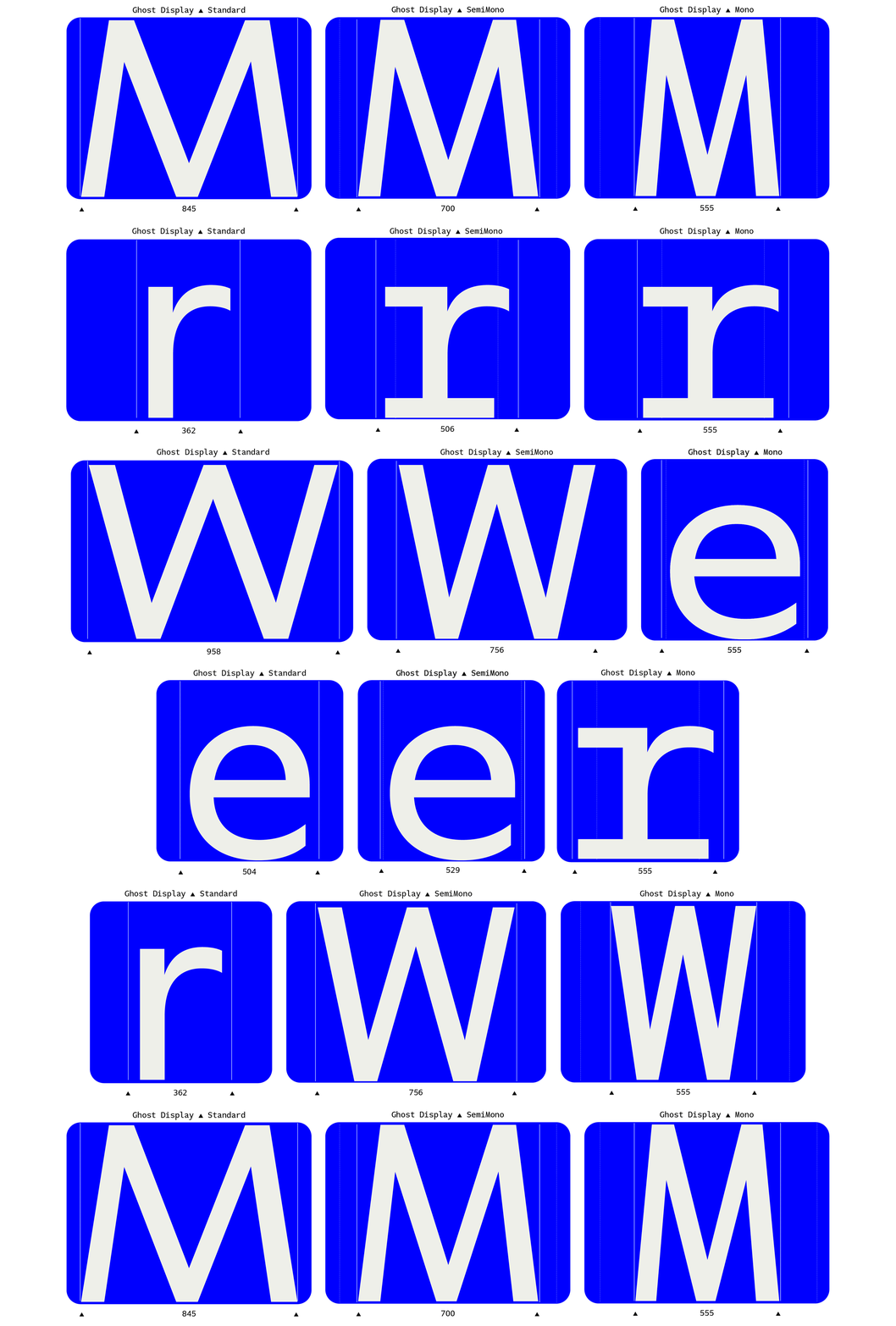
Ghost Superfamily is here, newly present and fully formed. Originally released in 2022 in a single display family, Lucas Sharp’s playful yet reverent resurrection of the Humanist sans debuted as an argument for a new standard in type design. Working backwards from the genre’s origins in Roman inscriptional writing, through the representational lens of Edward Johnston’s mechanically constructed forebears, Ghost’s chimeric identity was designed for adaptability, with a distinctive personality unbeholden to genre yet dexterous in its diachronic construction.
Through seamless variable axes that scale across display, text, and coding functions, Ghost Superfamily delves into the full potential of variable font technology, giving us the opportunity to explore its applications twofold as our most robust design tool for typographers, and as a new technological standard in our craft. Lucas, with My-Lan Thuong, Léna Le Pommelet, and Daniel Veneklaas, spent four years developing the superfamily, which now includes seventy-two styles across five weights with an optical size and mono axes, all integrated into a single variable designspace.
Through seamless variable axes that scale across display, text, and coding functions, Ghost Superfamily delves into the full potential of variable font technology, giving us the opportunity to explore its applications twofold as our most robust design tool for typographers, and as a new technological standard in our craft. Lucas, with My-Lan Thuong, Léna Le Pommelet, and Daniel Veneklaas, spent four years developing the superfamily, which now includes seventy-two styles across five weights with an optical size and mono axes, all integrated into a single variable designspace.
Designers: Lucas Sharp, My-Lan Thuong, Léna Le Pommelet, and Daniel Veneklaas | Engineer: Connor Davenport, Calvin Kwok | Kerning: Igino Marini
Version History
V.1 Apr 2022V.2 Apr 2026
▼
▼
Emoticon
Netscape
▼
▼
Pokemons
Download
▼
▼
LaraCroft
Vaporeon
▼
▼
Samantha
Morpheus
▼
▼
Meangirl
Bedazzle
▼
▼
Ravewear
Clueless
ExtraBold
38
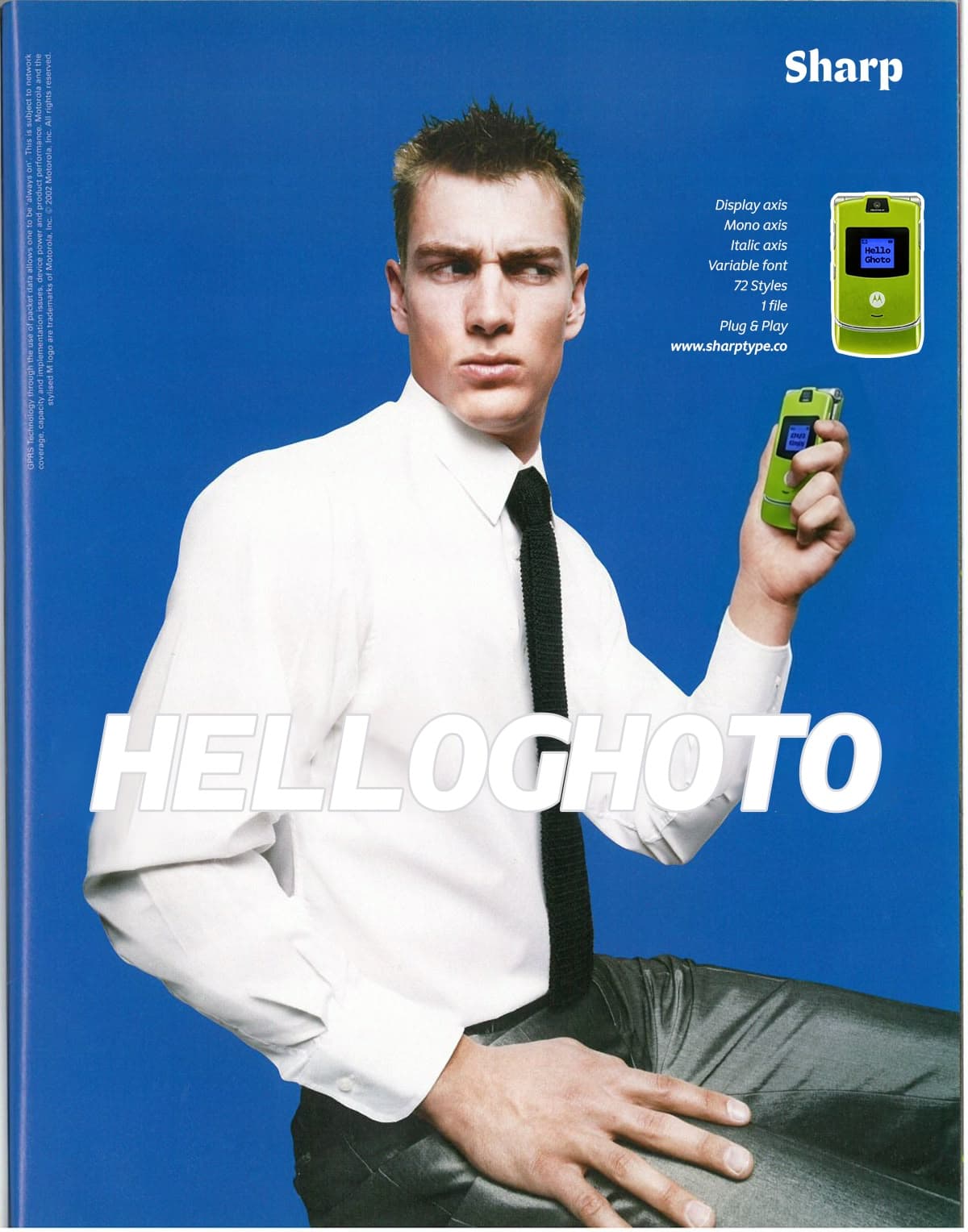
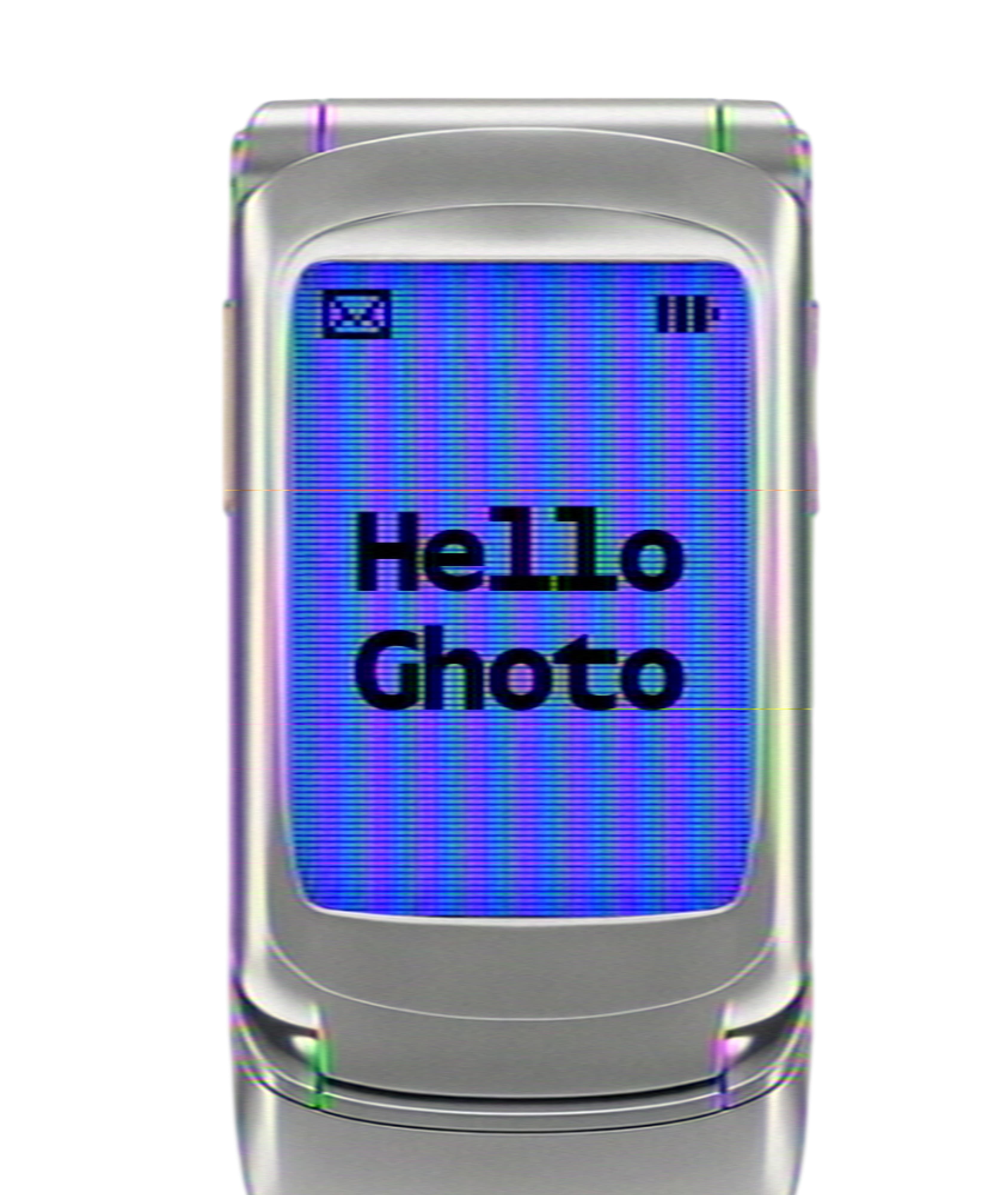
The Razr V3 was an ultra-thin clam shell mobile phone designed by Chris Arnholt under the codename Razor, with the name later shortened by marketing executive Geoffrey Frost. The device measured under 14 millimetres thick when folded, used an aluminium body, an electro luminescent keypad cut from a single metal wafer, and an external glass screen rather than the plastic windows used by competitors. Internal specifications were comparable to Motorola's mid-range V500 and V600
Loading…
0
300
0
0
Loading…
0
0
ExtraBold
aaaaaa
▼
▼
ExtraBold
32
Released by Nokia in September 2000 as the successor to the Nokia 3210. The 3310 housed a monochrome LCD with a five-line text display, a 900/1800 MHz dual-band GSM modem, an 84-by-48-pixel screen, the Snake II game, the T9 predictive text input system, and a removable BL-5C battery. The device became one of the most-produced phones in history, with approximately 126 million units sold across its production run, and acquired a cultural reputation for indestructibility that has persisted into the meme economy of the present. The 3310 was relaunched in 2017 by HMD Global as a feature-phone reissue with a colour screen and updated radio.
Bold
32
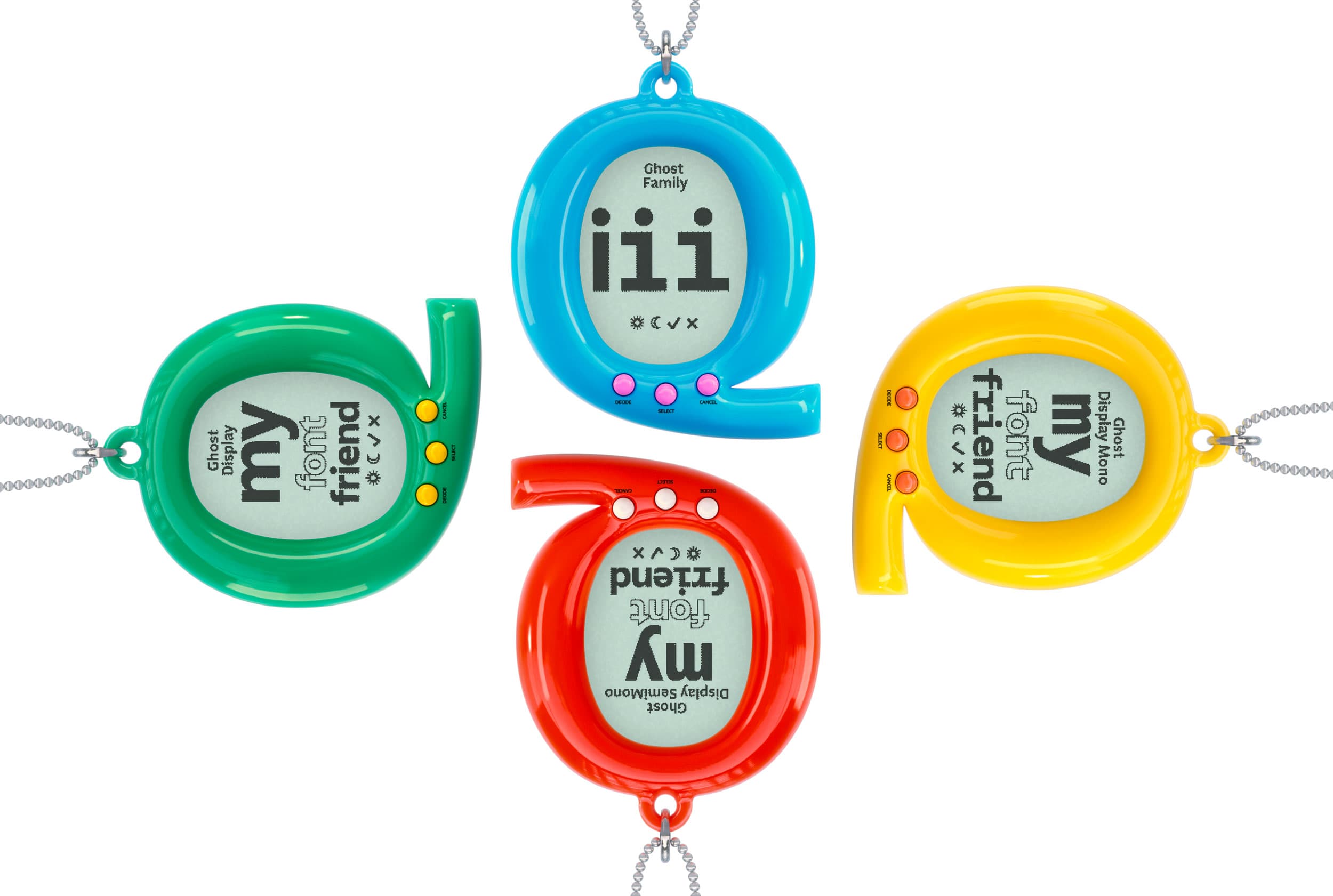
Co-created by Akihiro Yokoi of WiZ and Aki Maita of Bandai, who jointly received the 1997 Ig Nobel Prize in Economics for the toy's measurable effect on global productivity. The original device is an egg-shaped plastic shell containing a grayscale LCD, three buttons, and a small program in which a virtual creature must be fed, played with, cleaned, and disciplined to maturity. Neglect produces illness or death. The name is a portmanteau of the Japanese tamago (egg) and the loanword uotchi (watch). Over 98 million units have been sold worldwide as of 2025. The Tamagotchi was the first widely successful virtual pet and was followed by Tiger Electronics' Giga Pets, PlayMates' Nano Pets, and Tiger's Furby, which together defined the late-1990s electronic-toy market.
ExtraBold
16
The device housed an 8-bit Z80-derived processor running at 4 or 8 MHz, 32 KB of RAM, and a 160×144-pixel reflective colour LCD with no backlight. It was sold in Berry, Grape, Kiwi, Dandelion, Teal, Atomic Purple, and several limited editions. Backward compatibility with the original Game Boy library meant that Tetris and the first generation of Pokémon games remained playable on the new hardware. The system was succeeded in 2001 by the Game Boy Advance and remains, in retrospect, the canonical handheld of the late 1990s. Atomic Purple, the translucent variant introduced in 1999, has subsequently become one of the period's most-recognised consumer-product colourways. Sega Dreamcast Released November 27, 1998, in Japan, September 9, 1999, in North America, and October 14, 1999, in Europe. The first sixth-generation home console, predating the PlayStation 2 by approximately twenty months. The Dreamcast featured a 200 MHz Hitachi SH-4 CPU, a PowerVR2 graphics processor, 16 MB of system RAM, a built-in 56k modem for online play, and a proprietary GD-ROM optical disc format. The console's Visual Memory Unit, a memory-card-and-secondary-screen hybrid that fitted into the controller, anticipated later second-screen gaming concepts by more than a decade. Despite critical acclaim, weak software sales and competition from the imminent PlayStation 2 led Sega to discontinue the console on March 31, 2001, ending the company's hardware business permanently.
Bold
16
Personal digital assistant line introduced by Palm Computing in March 1996 with the Pilot 1000 and Pilot 5000 models. The Y2K-era flagship was the Palm V, released in February 1999, which housed a 16 MHz Motorola Dragonball EZ processor, 2 MB of RAM, a 160×160-pixel monochrome touchscreen, and was operated principally with a stylus and the Graffiti handwriting recognition system. The Palm V's anodised-aluminium case was designed by IDEO and represented a significant aesthetic departure from earlier plastic-bodied PDAs. The line continued through the Palm m500 series (2001), the Tungsten T (2002), and the Treo smartphone series (from 2002), before the company's gradual decline through the mid-2000s. Palm OS devices defined the consumer-PDA category that the smartphone would eventually subsume. A MiniDisc is a 64-millimetre magneto-optical disc enclosed in a plastic shuttle, capable of holding 74 or 80 minutes of audio at standard quality. The format used Sony's ATRAC compression and supported recording, track editing, and titling directly on the device. Notable players included the MZ-R30 (1996), the MZ-R55, the MZ-E10 (the thinnest portable player ever produced at 9.9 millimetres), and the Hi-MD line introduced in 2004. Despite a devoted user base, MiniDisc never achieved significant traction in North America and was effectively rendered obsolete by the iPod and other hard-drive-based players. Sony formally discontinued the format in 2013.
ExtraBold
57
AAAAAA BBBBBB CCCCCC DDDDDD EEEEEE FFFFFF GGGGGG HHHHHH IIIIII JJJJJJ KKKKKK LLLLLL MMMMMM NNNNNN OOOOOO PPPPPP QQQQQQ RRRRRR SSSSSS TTTTTT UUUUUU VVVVVV WWWWWW XXXXXX YYYYYY ZZZZZZ
▼
▼
SemiBold
32
Line of mobile devices produced by Research in Motion, beginning with the 850 pager in January 1999 and extending through the 957 (2000), the 5810 (2002), the 6210 (2003), and the 7230 (2003), the latter of which introduced the colour screen and the form factor that would define the line through the late 2000s. The BlackBerry distinguished itself through push email, the QWERTY thumb keyboard, and the trackwheel-and-later-trackball navigation system, all delivered through a mobile data network rather than over Wi-Fi. The device became the standard productivity tool of the corporate and political classes during the early 2000s, earning the nickname CrackBerry for its addictive properties before being supplanted by the iPhone and Android handsets in the late-2000s smartphone
Medium
32
A MiniDisc is a 64-millimetre magneto-optical disc enclosed in a plastic shuttle, capable of holding 74 or 80 minutes of audio at standard quality. The format used Sony's ATRAC compression and supported recording, track editing, and titling directly on the device. Notable players included the MZ-R30 (1996), the MZ-R55, the MZ-E10 (the thinnest portable player ever produced at 9.9 millimetres), and the Hi-MD line introduced in 2004. Despite a devoted user base, MiniDisc never achieved significant traction in North America and was effectively rendered obsolete by the iPod and other hard-drive-based players. Sony formally discontinued the format in 2013.
SemiBold
16
Line of mobile devices produced by Research in Motion, beginning with the 850 pager in January 1999 and extending through the 957 (2000), the 5810 (2002), the 6210 (2003), and the 7230 (2003), the latter of which introduced the colour screen and the form factor that would define the line through the late 2000s. The BlackBerry distinguished itself through push email, the QWERTY thumb keyboard, and the trackwheel-and-later-trackball navigation system, all delivered through a mobile data network rather than over Wi-Fi. The device became the standard productivity tool of the corporate and political classes during the early 2000s, earning the nickname CrackBerry for its addictive properties before being supplanted by the iPhone and Android handsets in the late-2000s smartphone. The period's cameras typically housed CCD sensors of two to five megapixels, used SmartMedia, CompactFlash, Memory Stick, or xD-Picture Card storage, displayed images on small rear LCDs, and connected to host computers through USB 1.1 or, in earlier models, serial cables. Photographs were small, colour-shifted, often blurred, and frequently dated in the corner by an LCD that had been set to the wrong year in 1998 and never updated. The flash photograph taken at arm's length and angled downward established compositional conventions that anticipated the front-facing camera by nearly a decade.
Medium
16
T-Mobile-branded mobile device produced by Danger Inc., released in October 2002. The Sidekick featured a swivelling display that rotated to reveal a full QWERTY keyboard, a colour screen, an always-on data connection, and integrated AOL Instant Messenger and email clients. The device occupied an unusual cultural niche, simultaneously serving as a status object for hip-hop artists and entertainment-industry figures and as one of the first mainstream mobile devices designed around continuous internet messaging rather than around voice calls. Notable users included Paris Hilton, whose Sidekick II was famously hacked in 2005, leaking the contents of her address book onto the early social internet. Category that crossed from professional novelty to consumer mainstream during the Y2K period. Defining models include the Canon PowerShot S100 Digital Elph (released April 2000, 2.1 megapixels), the Sony Cyber-shot DSC-P1 (2000, 3.3 megapixels), the Nikon Coolpix 990 (2000, 3.34 megapixels), and the Olympus Stylus 300 (2003, 3.2 megapixels). The period's cameras typically housed CCD sensors of two to five megapixels, used SmartMedia, CompactFlash, Memory Stick, or xD-Picture Card storage, displayed images on small rear LCDs, and connected to host computers through USB 1.1 or, in earlier models, serial cables. Photographs were small, colour-shifted, often blurred, and frequently dated in the corner by an LCD that had been set to the wrong year in 1998 and never updated. The flash photograph taken at arm's length and angled downward established compositional conventions that anticipated the front-facing camera by nearly a decade.
▼
▼
▼
Regular
32
Developed by Nintendo EAD under the direction of Shigeru Miyamoto, with production beginning on September 7, 1994, and concluding on May 20, 1996. The first 3D Mario game and a launch title for the Nintendo 64. The player navigates Mario through fifteen distinct courses entered via magical paintings inside Princess Peach's Castle, collecting 120 Power Stars to unlock progressively deeper sections of the hub world.
Light
32
The single-screen game is set in the sewers of New York City, with the brothers tasked with defeating turtles, crabs, and flies that emerge from pipes by striking the platforms beneath them. Mario Bros. introduced the green pipe as a recurring environmental element, the POW Block, and the convention of cooperative two-player platforming that would persist through the series.
Regular
16
Mario is a media franchise produced by the Japanese video game company Nintendo, originating with the 1981 arcade game Donkey Kong and the 1983 arcade game Mario Bros., and named after the moustachioed character who appears in both. The series was created and is principally directed by Shigeru Miyamoto, working in collaboration with designer Takashi Tezuka, programmer Toshihiko Nakago, and composer Koji Kondo, among many others. As of 2025, the broader Mario franchise has sold more than eight hundred million units worldwide and is the best-selling video game franchise in history. The series is centred on a fictional Mushroom Kingdom inhabited by mushroom-like Toads, the recurring antagonist Bowser, and the kidnap-prone Princess Peach. While the central platformer line is referred to as Super Mario, the franchise has expanded across racing, sports, role-playing, party, and educational genres. What follows is an index of the principal entries, sub-series, and recurring elements that constitute the Mario universe. Released in arcades in July 1981, designed by Shigeru Miyamoto. The first appearance of the character then known as Jumpman, who would later be renamed Mario, and the game responsible for rescuing Nintendo's struggling American operations from the commercial failure of Radar Scope. The player ascends a series of construction-site platforms while avoiding rolling barrels thrown by the titular gorilla, attempting to rescue a captive woman initially named Lady and later renamed Pauline. Donkey Kong established the platformer genre's core grammar of jumping, ladder-climbing, and obstacle avoidance. The game's success prompted a 1982 sequel, Donkey Kong Jr., in which the player-character roles are reversed: the now-imprisoned Donkey Kong must be rescued by his son from Mario, who appears as the antagonist for the only time in the franchise.
Light
16
Released in arcades in July 1981, designed by Shigeru Miyamoto. The first appearance of the character then known as Jumpman, who would later be renamed Mario, and the game responsible for rescuing Nintendo's struggling American operations from the commercial failure of Radar Scope. The player ascends a series of construction-site platforms while avoiding rolling barrels thrown by the titular gorilla, attempting to rescue a captive woman initially named Lady and later renamed Pauline. Donkey Kong established the platformer genre's core grammar of jumping, ladder-climbing, and obstacle avoidance. The game's success prompted a 1982 sequel, Donkey Kong Jr., in which the player-character roles are reversed: the now-imprisoned Donkey Kong must be rescued by his son from Mario, who appears as the antagonist for the only time in the franchise. Released in arcades in 1983 and ported to the Famicom and Nintendo Entertainment System in subsequent years. Designed by Shigeru Miyamoto and Gunpei Yokoi. The first game to establish Mario as a plumber, working alongside his green-clad brother Luigi, who was created by recolouring Mario's sprite to permit two-player cooperative play. The single-screen game is set in the sewers of New York City, with the brothers tasked with defeating turtles, crabs, and flies that emerge from pipes by striking the platforms beneath them. Mario Bros. introduced the green pipe as a recurring environmental element, the POW Block, and the convention of cooperative two-player platforming that would persist through the series.
ExtraBold
ffffff
▼
▼
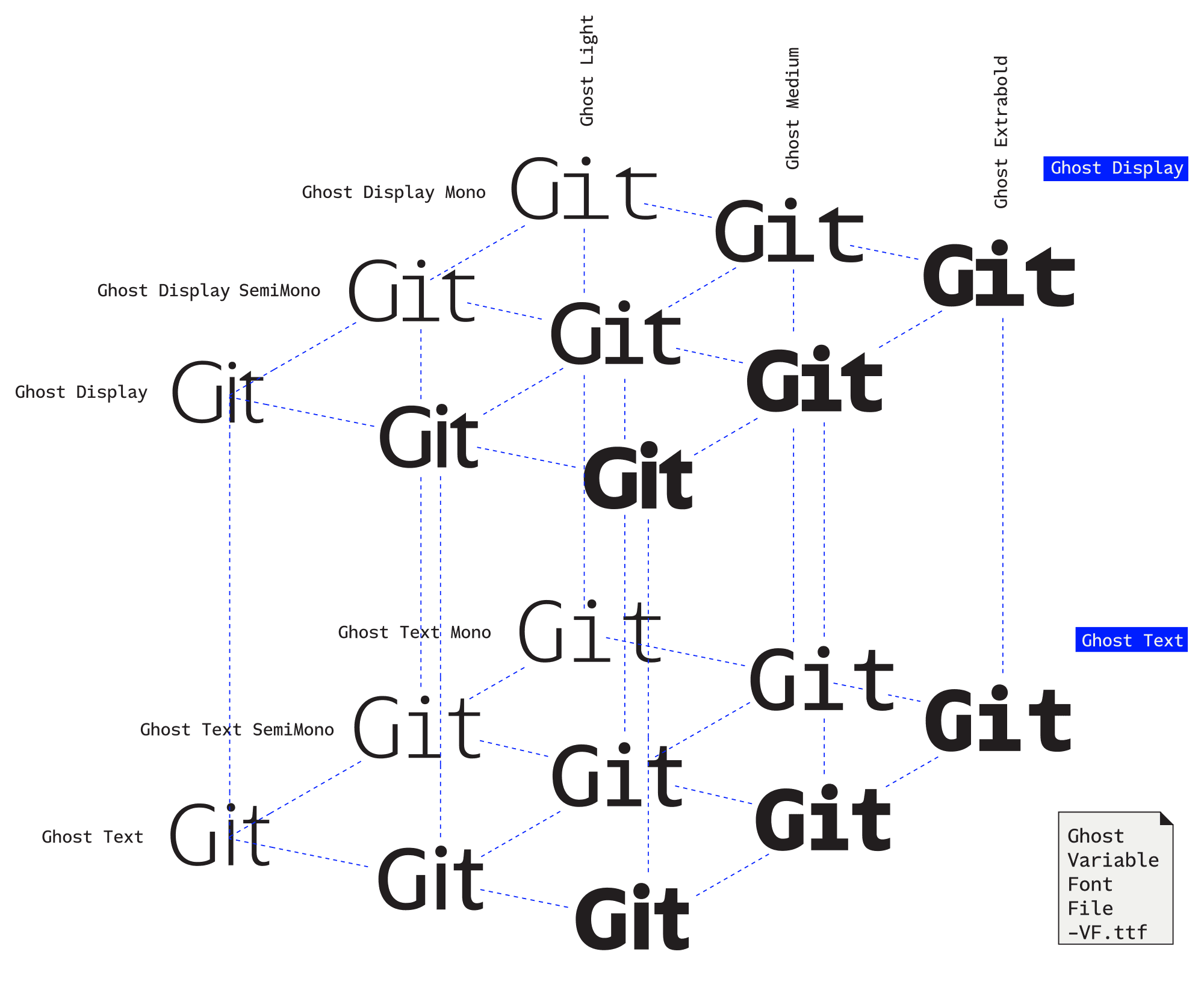
Through seamless variable axes that scale across display, text, and coding functions, Ghost Superfamily delves into the full potential of variable font technology, giving us the opportunity to explore its applications twofold as our most robust design tool for typographers, and as a new technological standard in our craft. We spent four years developing the superfamily, which now includes seventy-two styles across five weights with an optical size and mono axes, all integrated into a single variable designspace.
Loading…
calt
Contextual Alternates
case
Case-Sensitive Forms
ccmp
Glyph Composition/Decomposition
dlig
Discretionary Ligatures
dnom
Denominators
frac
Fractions
liga
Standard Ligatures
lnum
Lining Figures
locl
Localized Forms
numr
Numerators
onum
Oldstyle Figures
ordn
Ordinals
pnum
Proportional Figures
ss01
Alternate a (roman)
ss02
Alternate k (italic)
ss03
Alternate IJ
ss04
Alternate Arrows
ss05
Alternate boxes
ss06
Circled Numbers
ss07
Roman Numerals
subs
Subscript
sups
Superscript
tnum
Tabular Figures
Abron, Acheron, Achinese, Acholi, Achuar-Shiwiar, Adangme, Afar, Afrikaans, Aguaruna, Ahtna, Akoose, Alekano, Aleut, Algonquin, Amahuaca, Amarakaeri, Amis, Anaang, Andaandi, Anufo, Anuta, Ao Naga, Apinayé, Arabela, Aragonese, Arbëreshë Albanian, Arvanitika Albanian, Asháninka, Ashéninka Perené, Asu (Tanzania), Atayal, Awa-Cuaiquer, Awing, Baatonum, Bafia, Balinese, Bambara, Banjar, Baoulé, Bari, Basque, Batak Dairi, Batak Karo, Batak Mandailing, Batak Simalungun, Batak Toba, Bemba (Zambia), Bena (Tanzania), Biali, Bikol, Bini, Bislama, Boko (Benin), Bora, Borana-Arsi-Guji Oromo, Bosnian, Breton, Buginese, Candoshi-Shapra, Caquinte, Caribbean Hindustani, Cashibo-Cacataibo, Cashinahua, Catalan, Cebuano, Central Aymara, Central Kurdish, Central Nahuatl, Cerma, Chachi, Chamorro, Chavacano, Chayahuita, Chiga, Chiltepec Chinantec, Chokwe, Chuukese, Cimbrian, Cofán, Congo Swahili, Cook Islands Māori, Cornish, Corsican, Creek, Crimean Tatar, Croatian, Czech, Danish, Dehu, Dendi (Benin), Dimli, Dutch, Dyula, Eastern Arrernte, Eastern Maninkakan, Eastern Oromo, Efik, Embu, English, Ese Ejja, Esperanto, Ewondo, Fanti, Faroese, Fijian, Filipino, Finnish, French, Friulian, Ga, Gagauz, Galician, Ganda, Garifuna, Ga'anda, German, Gheg Albanian, Gilbertese, Gonja, Gooniyandi, Gourmanchéma, Guadeloupean Creole French, Gusii, Gwichʼin, Haitian, Hani, Hiligaynon, Ho-Chunk, Hopi, Huastec, Hungarian, Hän, Ibibio, Icelandic, Ido, Idoma, Iloko, Inari Sami, Indonesian, Interglossa, Interlingua, Interlingue, Irish, Istro Romanian, Italian, Ixcatlán Mazatec, Jamaican Creole English, Javanese, Jenaama Bozo, Jola-Fonyi, K'iche', Kabuverdianu, Kaingang, Kala Lagaw Ya, Kalaallisut, Kalenjin, Kamba (Kenya), Kaonde, Kaqchikel, Karelian, Kashubian, Kekchí, Kenzi/Mattokki, Khasi, Kikuyu, Kimbundu, Kinyarwanda, Kirmanjki, Kituba (DRC), Klingon, Kongo, Konzo, Koyra Chiini Songhay, Koyraboro Senni Songhai, Krio, Kuanyama, Kven Finnish, Kölsch, Ladin, Ladino, Langi, Latgalian, Ligurian, Lingala, Lithuanian, Lojban, Lombard, Low German, Lower Sorbian, Lozi, Luba-Katanga, Luba-Lulua, Lule Sami, Luo (Kenya and Tanzania), Luxembourgish, Macedo-Romanian, Makhuwa, Makhuwa-Meetto, Makonde, Makwe, Malagasy, Malaysian, Maltese, Mamara Senoufo, Mandinka, Mandjak, Mankanya, Manx, Maore Comorian, Maori, Mapudungun, Marshallese, Masai, Matsés, Mauritian Creole, Mende (Sierra Leone), Meriam Mir, Meru, Meta', Metlatónoc Mixtec, Mi'kmaq, Minangkabau, Mirandese, Moba, Mohawk, Montagnais, Montenegrin, Munsee, Murrinh-Patha, Murui Huitoto, Muslim Tat, Mwani, Mískito, Naga Pidgin, Ndonga, Neapolitan, Ngazidja Comorian, Niuean, Nobiin, Nomatsiguenga, North Azerbaijani, North Ndebele, Northern Kissi, Northern Kurdish, Northern Qiandong Miao, Northern Sami, Northern Uzbek, Northwestern Ojibwa, Norwegian, Novial, Nyamwezi, Nyanja, Nyankole, Nyemba, Nzima, Occitan, Ojitlán Chinantec, Omaha-Ponca, Orma, Oroqen, Otuho, Palauan, Paluan, Pampanga, Papantla Totonac, Papiamento, Paraguayan Guaraní, Pedi, Picard, Pichis Ashéninka, Piemontese, Pijin, Pintupi-Luritja, Pipil, Pite Sami, Pohnpeian, Polish, Portuguese, Potawatomi, Purepecha, Páez, Quechua, Romanian, Romansh, Rotokas, Rundi, Rwa, Samburu, Samoan, Sango, Sangu (Tanzania), Saramaccan, Sardinian, Scots, Scottish Gaelic, Sena, Seri, Seselwa Creole French, Shambala, Sharanahua, Shawnee, Shilluk, Shipibo-Conibo, Shona, Shuar, Sicilian, Silesian, Slovak, Slovenian, Soga, Somali, Soninke, South Azerbaijani, South Ndebele, Southern Aymara, Southern Bobo Madaré, Southern Dagaare, Southern Qiandong Miao, Southern Sami, Southern Sotho, Spanish, Sranan Tongo, Standard Estonian, Standard Latvian, Standard Malay, Sundanese, Susu, Swahili, Swati, Swedish, Swiss German, Syenara Senoufo, Tagalog, Tahitian, Taita, Talysh, Tasawaq, Tedim Chin, Tetum, Tetun Dili, Timne, Tiv, Tiéyaxo Bozo, Toba, Tok Pisin, Tokelau, Toki Pona, Tonga (Tonga Islands), Tonga (Zambia), Tosk Albanian, Tsakhur, Tsonga, Tswana, Tumbuka, Turkish, Turkmen, Tuvalu, Twi, Tzeltal, Tzotzil, Uab Meto, Umbundu, Ume Sami, Upper Guinea Crioulo, Upper Sorbian, Urarina, Venetian, Veps, Volapük, Võro, Waama, Walloon, Walser, Wamey, Wangaaybuwan-Ngiyambaa, Waorani, Waray (Philippines), Warlpiri, Wasa, Wayuu, Welsh, West Central Oromo, West-Central Limba, Western Abnaki, Western Frisian, Wik-Mungkan, Wiradjuri, Wolof, Xavánte, Xhosa, Yagua, Yanesha', Yangben, Yanomamö, Yao, Yapese, Yindjibarndi, Yucateco, Zarma, Zulu, Zuni, Záparo