Loading…
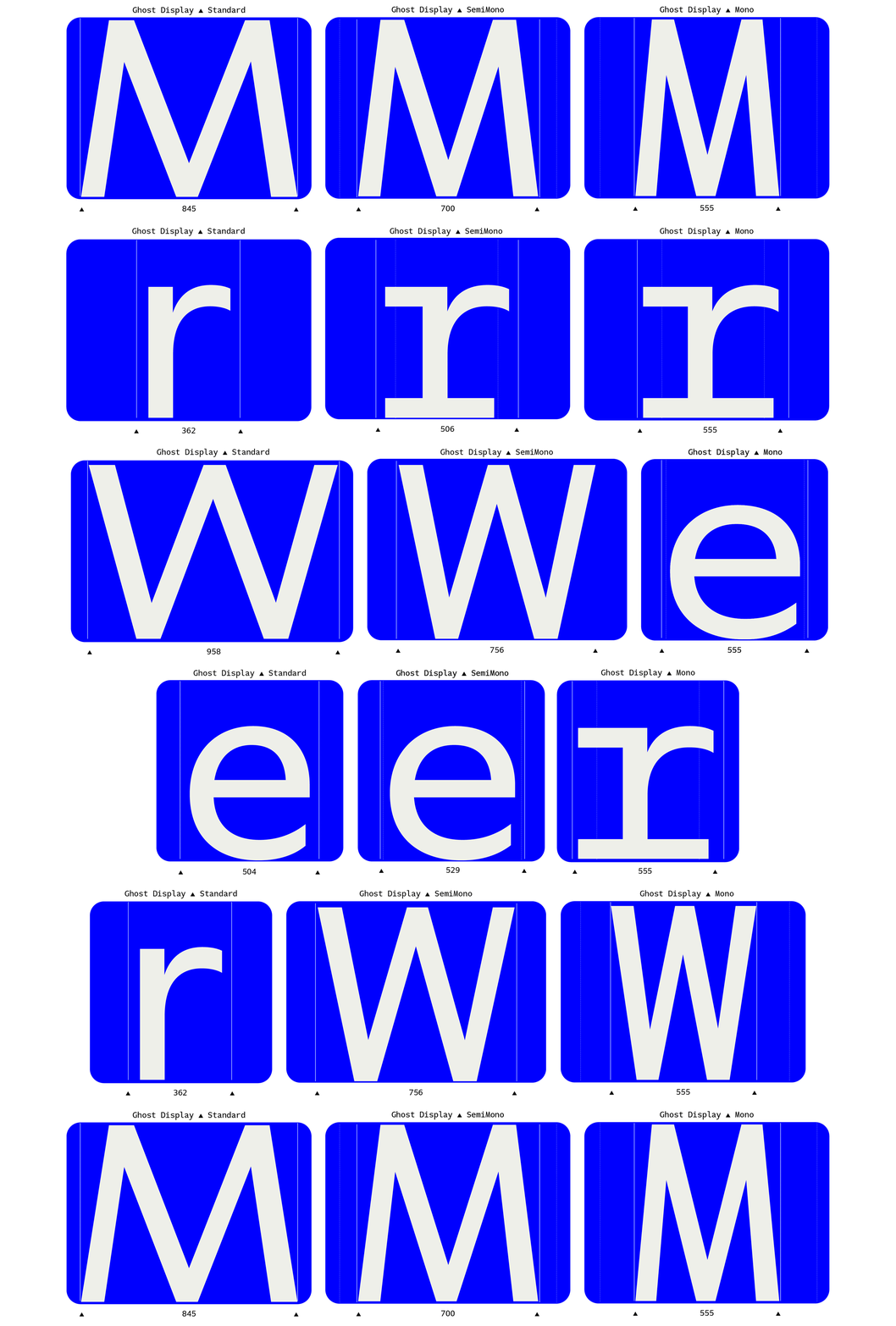
Ghost Display SemiMono
Ghost Superfamily is here, newly present and fully formed. Originally released in 2022 in a single display family, Lucas Sharp’s playful yet reverent resurrection of the Humanist sans debuted as an argument for a new standard in type design. Working backwards from the genre’s origins in Roman inscriptional writing, through the representational lens of Edward Johnston’s mechanically constructed forebears, Ghost’s chimeric identity was designed for adaptability, with a distinctive personality unbeholden to genre yet dexterous in its diachronic construction.
Through seamless variable axes that scale across display, text, and coding functions, Ghost Superfamily delves into the full potential of variable font technology, giving us the opportunity to explore its applications twofold as our most robust design tool for typographers, and as a new technological standard in our craft. Lucas, with My-Lan Thuong, Léna Le Pommelet, and Daniel Veneklaas, spent four years developing the superfamily, which now includes seventy-two styles across five weights with an optical size and mono axes, all integrated into a single variable designspace.
Through seamless variable axes that scale across display, text, and coding functions, Ghost Superfamily delves into the full potential of variable font technology, giving us the opportunity to explore its applications twofold as our most robust design tool for typographers, and as a new technological standard in our craft. Lucas, with My-Lan Thuong, Léna Le Pommelet, and Daniel Veneklaas, spent four years developing the superfamily, which now includes seventy-two styles across five weights with an optical size and mono axes, all integrated into a single variable designspace.
Designers: Lucas Sharp, My-Lan Thuong, Léna Le Pommelet, and Daniel Veneklaas | Engineer: Connor Davenport, Calvin Kwok | Kerning: Igino Marini
Version History
V.1 Apr 2022V.2 Apr 2026
▼
▼
Neotokyo
Spectral
▼
▼
Futurists
Wraithes
▼
▼
Institute
Romantic
▼
▼
Trisolari
Gamecube
▼
▼
Electrons
Nanochip
▼
▼
Singulars
Roppongi
Loading…
0
300
0
0
Loading…
300
0
Mixed Styles
50
AAAAAA BBBBBB CCCCCC DDDDDD EEEEEE FFFFFF GGGGGG HHHHHH IIIIII JJJJJJ KKKKKK LLLLLL MMMMMM NNNNNN OOOOOO PPPPPP QQQQQQ RRRRRR SSSSSS TTTTTT UUUUUU VVVVVV WWWWWW XXXXXX YYYYYY ZZZZZZ
▼
▼
ExtraBold
40
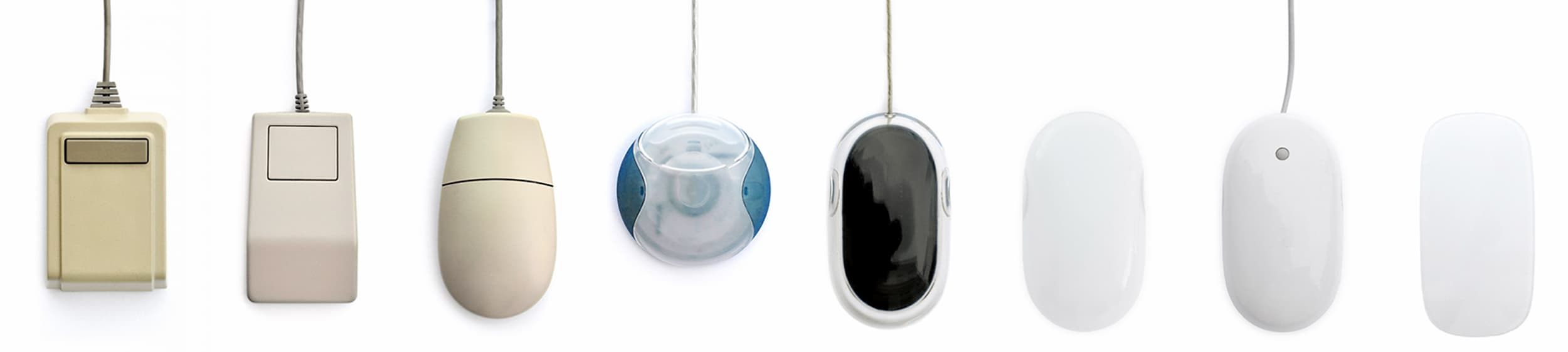
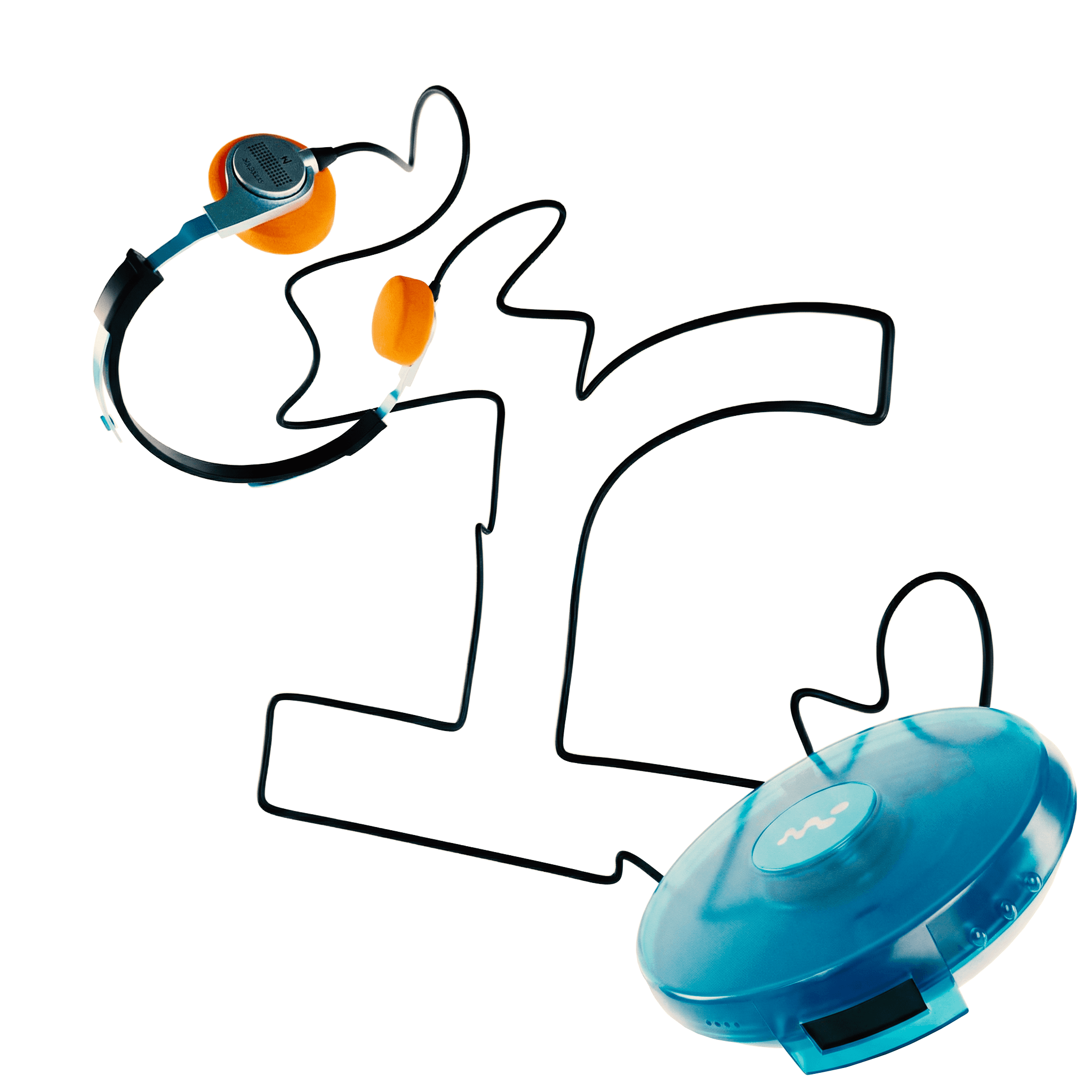
Also referred to as Cyber Y2K or, originally, simply Y2K Aesthetic. Prevalent from roughly 1997 to 2004 and defined by a distinct techno-utopian optimism drawing visual influence from the iMac G3, the dot-com boom, and rapidly advancing computer-generated imagery. The aesthetic uses futuristic graphic design and blobby CGI, often featuring a color palette of chrome, icy blue, glossy white, and bright citrus accents.
ExtraBold
32
Metalheart was popular in album covers, film posters, and the title sequences of action and science-fiction productions. The aesthetic's mood is colder and more anxious than that of Y2K Futurism, and it has formed a particularly important reference point for the more recent Y3K movement.
ExtraBold
22
Vectorheart A graphic design style that emerged in the mid-to-late 1990s and continued through the early 2000s. Characterized by striking vector shapes, dynamic diagonal lines, futuristic display fonts, and flat high-contrast color palettes. Vectorheart was commonly found in the branding for video games, technology products, electronic music labels, and youth-oriented apparel. The aesthetic was closely associated with the British design collective The Designers Republic, founded by Ian Anderson in Sheffield in 1986 and responsible for the visual identity of WipEout, Pop Will Eat Itself, Warp Records, and a great deal of the era's most influential record packaging. Vectorheart's flat geometric vocabulary distinguished it from the rounder, more rendered surfaces of Y2K Futurism proper, and it remains one of the most-revived sub-aesthetics of the period. Vectorheart A graphic design style that emerged in the mid-to-late 1990s and continued through the early 2000s. Characterized by striking vector shapes, dynamic diagonal lines, futuristic display fonts, and flat high-contrast color palettes. Vectorheart was commonly found in the branding for video games, technology products, electronic music labels, and youth-oriented apparel. The aesthetic was closely associated with the British design collective The Designers Republic, founded by Ian Anderson in Sheffield in 1986 and responsible for the visual identity of WipEout, Pop Will Eat Itself, Warp Records, and a great deal of the era's most influential record packaging. Vectorheart's flat geometric vocabulary distinguished it from the rounder, more rendered surfaces of Y2K Futurism proper, and it remains one of the most-revived sub-aesthetics of the period.
Bold
22
A cyberpunk-influenced design aesthetic prevalent from roughly 1998 to 2004. Characterized by complex deformed abstract metallic shapes, futuristic user interfaces, and blurry atmospheric backgrounds, often in service of a darker and more complex vision of the future than Y2K Futurism's brighter optimism. The aesthetic frequently incorporated liquid-metal effects, fragmented geometry, lens distortions, and the suggestion of advanced but unreadable interface elements. Metalheart was popular in album covers, film posters, and the title sequences of action and science-fiction productions. The aesthetic's mood is colder and more anxious than that of Y2K Futurism, and it has formed a particularly important reference point for the more recent Y3K movement. A cyberpunk-influenced design aesthetic prevalent from roughly 1998 to 2004. Characterized by complex deformed abstract metallic shapes, futuristic user interfaces, and blurry atmospheric backgrounds, often in service of a darker and more complex vision of the future than Y2K Futurism's brighter optimism. The aesthetic frequently incorporated liquid-metal effects, fragmented geometry, lens distortions, and the suggestion of advanced but unreadable interface elements. Metalheart was popular in album covers, film posters, and the title sequences of action and science-fiction productions. The aesthetic's mood is colder and more anxious than that of Y2K Futurism, and it has formed a particularly important reference point for the more recent Y3K movement.
▼
▼
SemiBold
32
Donkey Kong Jr., in which the player-character roles are reversed: the now-imprisoned Donkey Kong must be rescued by his son from Mario, who appears as the antagonist for the only time in the franchise. A role-playing game series that began with Paper Mario for the Nintendo 64 on August 11, 2000, developed by Intelligent Systems. The series renders the Mario universe as a paper-craft diorama, with two-dimensional sprites moving through three-dimensional environments. Combat occurs in a turn-based system that integrates timed button presses to amplify damage and reduce damage taken.
Medium
32
Cheiron Crush Named after the Stockholm-based Cheiron Studios, the production house responsible for a remarkable proportion of the late-1990s and early-2000s Western pop canon. Cheiron Crush refers to the aesthetic environment built around the studio's output, which included Britney Spears's "...Baby One More Time," NSYNC's "I Want You Back," and the Backstreet Boys' "Quit Playing Games (with My Heart)." The visual register is characterized by lens-flared production, school-corridor settings, color-graded chrome and pastel palettes, and the convention of the music video as a polished, cinematically lit object rather than a documentary or performance recording.
SemiBold
22
Cybertwee: An aesthetic and online art movement founded in 2014 by artists Gabriella Hileman, May Waver, and Violet Forest as a deliberate counterpoint to the traditionally masculine, cynical, and often stark tone of Cyberpunk. Though strictly post-Y2K, Cybertwee draws heavily on the visual vocabulary of the Y2K period and is often grouped with its contemporary revivals. The aesthetic reinterprets technology through a lens of softness, cuteness, and femininity, prioritizing sincerity, empathy, and emotional expression within digital contexts. Visual motifs include pastel pinks and purples, glitter, holographic surfaces, kawaii imagery, lace, ruffles, and the recontextualization of pink-shelled consumer hardware such as the Motorola flip phone and the Nintendo GameCube controller. The collective's manifesto begins with the line "The singularity is dear." Cybertwee: An aesthetic and online art movement founded in 2014 by artists Gabriella Hileman, May Waver, and Violet Forest as a deliberate counterpoint to the traditionally masculine, cynical, and often stark tone of Cyberpunk. Though strictly post-Y2K, Cybertwee draws heavily on the visual vocabulary of the Y2K period and is often grouped with its contemporary revivals. The aesthetic reinterprets technology through a lens of softness, cuteness, and femininity, prioritizing sincerity, empathy, and emotional expression within digital contexts. Visual motifs include pastel pinks and purples, glitter, holographic surfaces, kawaii imagery, lace, ruffles, and the recontextualization of pink-shelled consumer hardware such as the Motorola flip phone and the Nintendo GameCube controller. The collective's manifesto begins with the line "The singularity is dear."
Medium
22
Neo-Y2K: A revival of Y2K Futurism that emerged in the late 2010s and gained mainstream popularity in the early 2020s. Coined by Evan Collins in 2016, the aesthetic in its foundational form emphasizes Eastern, particularly Japanese, graphic design influences, highly saturated colors, and a convergence with the metallic, liquid-like forms of Metalheart. In its broader interpretation, driven principally by TikTok, Neo-Y2K adapts the iconic fashion and pop culture of the original era for a Gen Z audience, blending nostalgia with modern sensibilities. The aesthetic is distinguished from its predecessor primarily by its motivation: where the original Y2K style was born from techno-optimism about an unknown digital future, Neo-Y2K is rooted in nostalgia for that same period, viewed from a present in which the digital future has already arrived Neo-Y2K: A revival of Y2K Futurism that emerged in the late 2010s and gained mainstream popularity in the early 2020s. Coined by Evan Collins in 2016, the aesthetic in its foundational form emphasizes Eastern, particularly Japanese, graphic design influences, highly saturated colors, and a convergence with the metallic, liquid-like forms of Metalheart. In its broader interpretation, driven principally by TikTok, Neo-Y2K adapts the iconic fashion and pop culture of the original era for a Gen Z audience, blending nostalgia with modern sensibilities. The aesthetic is distinguished from its predecessor primarily by its motivation: where the original Y2K style was born from techno-optimism about an unknown digital future, Neo-Y2K is rooted in nostalgia for that same period, viewed from a present in which the digital future has already arrived
ExtraBold
nnnnnn
▼
▼
Regular
32
Y3K an abbreviation for Year 3000. A contemporary aesthetic movement functioning as the futuristic evolution of Y2K Futurism. Y3K borrows the retro-futurist optimism of its predecessor but pushes it further, embracing an amplified and more refined look that leans into a colder, more dystopian atmosphere rendered with sharp precision.
Light
32
Metalheart was popular in album covers, film posters, and the title sequences of action and science-fiction productions. The aesthetic's mood is colder and more anxious than that of Y2K Futurism, and it has formed a particularly important reference point for the more recent Y3K movement.
▼
Regular
22
The Mario franchise occupies an unusual position in the history of popular media, comparable in cultural ubiquity to Mickey Mouse but distinguished by its grounding in interactive rather than passive entertainment. The character has appeared in over two hundred individual titles, has been voiced by Charles Martinet from 1995 to 2023 and by Kevin Afghani from 2023 onwards, and has been portrayed in feature film by Bob Hoskins (1993) and by Chris Pratt (2023). The Super Mario Bros. Movie, produced by Illumination and Nintendo and released on April 5, 2023, grossed approximately $1.36 billion worldwide and is the highest-grossing film based on a video game. The reader is encouraged to treat this index as a starting point for further exploration of a franchise whose central design principles have proven unusually durable across changing hardware, audiences, and decades. The Mushroom Kingdom is the franchise's principal setting, a realm populated by mushroom-headed Toads and ruled, however nominally, by Princess Peach. Power-ups including the Super Mushroom, Fire Flower, Starman, Super Leaf, Cape Feather, and Wing Cap permit Mario temporary expansions of his capabilities. The green warp pipe, the question-mark block, the brick block, the flagpole, and the underground bonus room recur as environmental constants. Recurring enemies include the Goomba, the Koopa Troopa, the Piranha Plant, the Bullet Bill, the Hammer Bro, the Cheep Cheep, the Lakitu, the Boo, and the Thwomp.
Light
22
A racing series that began with Super Mario Kart for the Super Nintendo Entertainment System on August 27, 1992. Designed by Hideki Konno, the original game introduced the conventions of split-screen multiplayer kart racing, item-based combat, and Mode 7 pseudo-3D track rendering. The series has continued through Mario Kart 64 (1996), Mario Kart: Super Circuit (2001), Mario Kart: Double Dash!! (2003), Mario Kart DS (2005), Mario Kart Wii (2008), Mario Kart 7 (2011), Mario Kart 8 (2014), Mario Kart 8 Deluxe (2017), and Mario Kart World (2025). Mario Kart 8 Deluxe has become the best-selling game in the franchise, with over sixty-eight million copies sold across its lifetime, and the series as a whole is the best-selling racing-game franchise in history. A series of digital-board-game compilations beginning with Mario Party for the Nintendo 64 on December 18, 1998, originally developed by Hudson Soft and later, from Mario Party 9 onward, by NDcube. Each entry presents a virtual board on which up to four players move using dice rolls, collecting coins and stars while contesting minigames at the end of each turn. The series is responsible for a substantial proportion of the franchise's reputation as a vehicle for casual social play and for the destruction of childhood friendships, an effect produced by the genre's combination of luck-based scoring and competitive minigame design. The most recent main entry, Super Mario Party Jamboree, was released for the Nintendo Switch on October 17, 2024.
ExtraBold
IIIIII
▼
▼
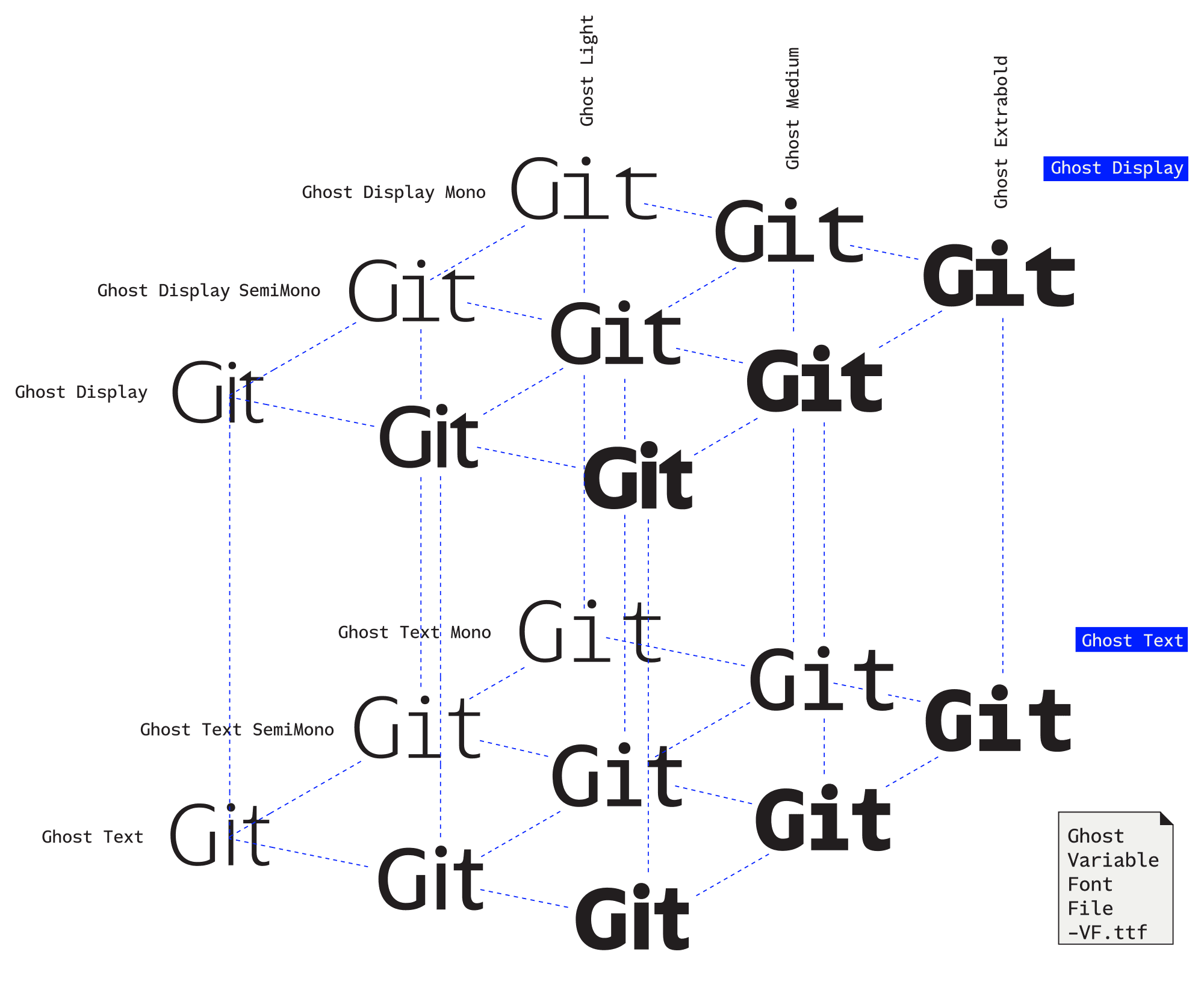
Through seamless variable axes that scale across display, text, and coding functions, Ghost Superfamily delves into the full potential of variable font technology, giving us the opportunity to explore its applications twofold as our most robust design tool for typographers, and as a new technological standard in our craft. We spent four years developing the superfamily, which now includes seventy-two styles across five weights with an optical size and mono axes, all integrated into a single variable designspace.
Loading…
calt
Contextual Alternates
case
Case-Sensitive Forms
ccmp
Glyph Composition/Decomposition
dlig
Discretionary Ligatures
dnom
Denominators
frac
Fractions
liga
Standard Ligatures
lnum
Lining Figures
locl
Localized Forms
numr
Numerators
onum
Oldstyle Figures
ordn
Ordinals
pnum
Proportional Figures
ss01
Alternate a (roman)
ss02
Alternate k (italic)
ss03
Alternate IJ
ss04
Alternate Arrows
ss05
Alternate boxes
ss06
Circled Numbers
ss07
Roman Numerals
subs
Subscript
sups
Superscript
tnum
Tabular Figures
Abron, Acheron, Achinese, Acholi, Achuar-Shiwiar, Adangme, Afar, Afrikaans, Aguaruna, Ahtna, Akoose, Alekano, Aleut, Algonquin, Amahuaca, Amarakaeri, Amis, Anaang, Andaandi, Anufo, Anuta, Ao Naga, Apinayé, Arabela, Aragonese, Arbëreshë Albanian, Arvanitika Albanian, Asháninka, Ashéninka Perené, Asu (Tanzania), Atayal, Awa-Cuaiquer, Awing, Baatonum, Bafia, Balinese, Bambara, Banjar, Baoulé, Bari, Basque, Batak Dairi, Batak Karo, Batak Mandailing, Batak Simalungun, Batak Toba, Bemba (Zambia), Bena (Tanzania), Biali, Bikol, Bini, Bislama, Boko (Benin), Bora, Borana-Arsi-Guji Oromo, Bosnian, Breton, Buginese, Candoshi-Shapra, Caquinte, Caribbean Hindustani, Cashibo-Cacataibo, Cashinahua, Catalan, Cebuano, Central Aymara, Central Kurdish, Central Nahuatl, Cerma, Chachi, Chamorro, Chavacano, Chayahuita, Chiga, Chiltepec Chinantec, Chokwe, Chuukese, Cimbrian, Cofán, Congo Swahili, Cook Islands Māori, Cornish, Corsican, Creek, Crimean Tatar, Croatian, Czech, Danish, Dehu, Dendi (Benin), Dimli, Dutch, Dyula, Eastern Arrernte, Eastern Maninkakan, Eastern Oromo, Efik, Embu, English, Ese Ejja, Esperanto, Ewondo, Fanti, Faroese, Fijian, Filipino, Finnish, French, Friulian, Ga, Gagauz, Galician, Ganda, Garifuna, Ga'anda, German, Gheg Albanian, Gilbertese, Gonja, Gooniyandi, Gourmanchéma, Guadeloupean Creole French, Gusii, Gwichʼin, Haitian, Hani, Hiligaynon, Ho-Chunk, Hopi, Huastec, Hungarian, Hän, Ibibio, Icelandic, Ido, Idoma, Iloko, Inari Sami, Indonesian, Interglossa, Interlingua, Interlingue, Irish, Istro Romanian, Italian, Ixcatlán Mazatec, Jamaican Creole English, Javanese, Jenaama Bozo, Jola-Fonyi, K'iche', Kabuverdianu, Kaingang, Kala Lagaw Ya, Kalaallisut, Kalenjin, Kamba (Kenya), Kaonde, Kaqchikel, Karelian, Kashubian, Kekchí, Kenzi/Mattokki, Khasi, Kikuyu, Kimbundu, Kinyarwanda, Kirmanjki, Kituba (DRC), Klingon, Kongo, Konzo, Koyra Chiini Songhay, Koyraboro Senni Songhai, Krio, Kuanyama, Kven Finnish, Kölsch, Ladin, Ladino, Langi, Latgalian, Ligurian, Lingala, Lithuanian, Lojban, Lombard, Low German, Lower Sorbian, Lozi, Luba-Katanga, Luba-Lulua, Lule Sami, Luo (Kenya and Tanzania), Luxembourgish, Macedo-Romanian, Makhuwa, Makhuwa-Meetto, Makonde, Makwe, Malagasy, Malaysian, Maltese, Mamara Senoufo, Mandinka, Mandjak, Mankanya, Manx, Maore Comorian, Maori, Mapudungun, Marshallese, Masai, Matsés, Mauritian Creole, Mende (Sierra Leone), Meriam Mir, Meru, Meta', Metlatónoc Mixtec, Mi'kmaq, Minangkabau, Mirandese, Moba, Mohawk, Montagnais, Montenegrin, Munsee, Murrinh-Patha, Murui Huitoto, Muslim Tat, Mwani, Mískito, Naga Pidgin, Ndonga, Neapolitan, Ngazidja Comorian, Niuean, Nobiin, Nomatsiguenga, North Azerbaijani, North Ndebele, Northern Kissi, Northern Kurdish, Northern Qiandong Miao, Northern Sami, Northern Uzbek, Northwestern Ojibwa, Norwegian, Novial, Nyamwezi, Nyanja, Nyankole, Nyemba, Nzima, Occitan, Ojitlán Chinantec, Omaha-Ponca, Orma, Oroqen, Otuho, Palauan, Paluan, Pampanga, Papantla Totonac, Papiamento, Paraguayan Guaraní, Pedi, Picard, Pichis Ashéninka, Piemontese, Pijin, Pintupi-Luritja, Pipil, Pite Sami, Pohnpeian, Polish, Portuguese, Potawatomi, Purepecha, Páez, Quechua, Romanian, Romansh, Rotokas, Rundi, Rwa, Samburu, Samoan, Sango, Sangu (Tanzania), Saramaccan, Sardinian, Scots, Scottish Gaelic, Sena, Seri, Seselwa Creole French, Shambala, Sharanahua, Shawnee, Shilluk, Shipibo-Conibo, Shona, Shuar, Sicilian, Silesian, Slovak, Slovenian, Soga, Somali, Soninke, South Azerbaijani, South Ndebele, Southern Aymara, Southern Bobo Madaré, Southern Dagaare, Southern Qiandong Miao, Southern Sami, Southern Sotho, Spanish, Sranan Tongo, Standard Estonian, Standard Latvian, Standard Malay, Sundanese, Susu, Swahili, Swati, Swedish, Swiss German, Syenara Senoufo, Tagalog, Tahitian, Taita, Talysh, Tasawaq, Tedim Chin, Tetum, Tetun Dili, Timne, Tiv, Tiéyaxo Bozo, Toba, Tok Pisin, Tokelau, Toki Pona, Tonga (Tonga Islands), Tonga (Zambia), Tosk Albanian, Tsakhur, Tsonga, Tswana, Tumbuka, Turkish, Turkmen, Tuvalu, Twi, Tzeltal, Tzotzil, Uab Meto, Umbundu, Ume Sami, Upper Guinea Crioulo, Upper Sorbian, Urarina, Venetian, Veps, Volapük, Võro, Waama, Walloon, Walser, Wamey, Wangaaybuwan-Ngiyambaa, Waorani, Waray (Philippines), Warlpiri, Wasa, Wayuu, Welsh, West Central Oromo, West-Central Limba, Western Abnaki, Western Frisian, Wik-Mungkan, Wiradjuri, Wolof, Xavánte, Xhosa, Yagua, Yanesha', Yangben, Yanomamö, Yao, Yapese, Yindjibarndi, Yucateco, Zarma, Zulu, Zuni, Záparo